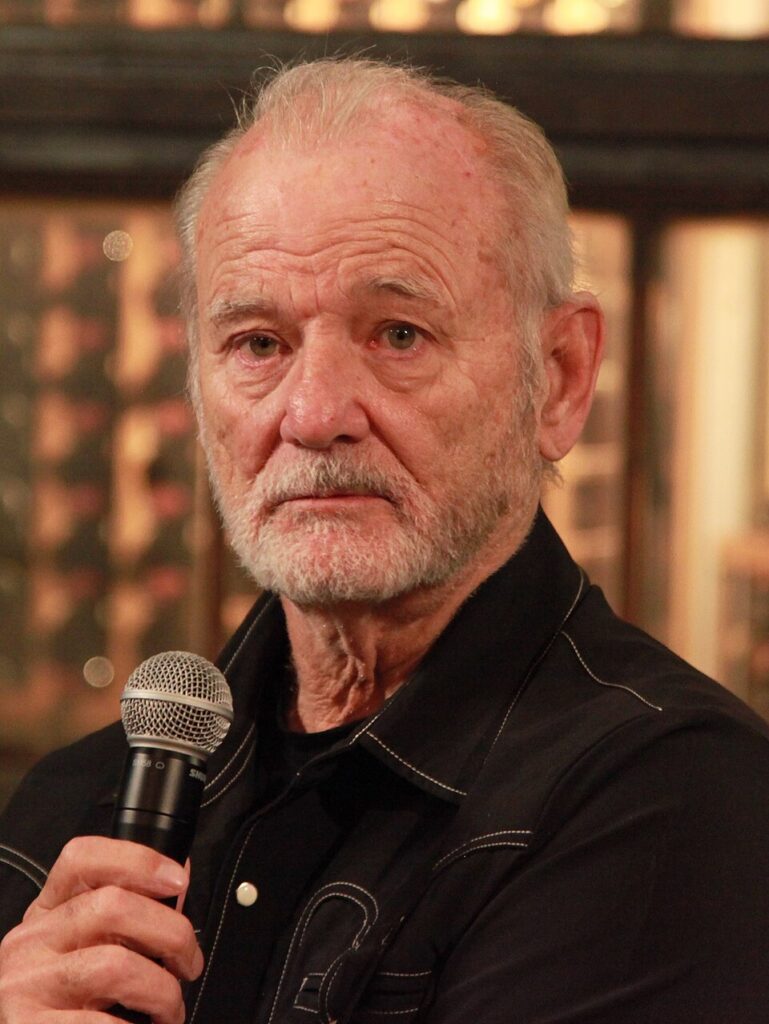
Bill Murray is a famous American actor and comedian, born on September 21, 1950, in Illinois, USA. He first became popular in the late 1970s as a cast member on the comedy show Saturday Night Live (SNL). His dry, relaxed, and sarcastic humor made him one of the most recognizable comedians in the U.S.
Early Life and Background
William James Murray was born on September 21, 1950, in Wilmette, Illinois, a suburb near Chicago. He was the fifth of nine children in an Irish-American Catholic family. His father, Edward Murray, worked as a lumber salesman, while his mother, Lucille, was a mail-room clerk. Growing up in such a large household taught Bill the art of humor early in life. Comedy became a tool for getting attention, diffusing tension, and simply surviving in a loud and energetic home.
As a young boy, Murray enjoyed reading, sports, and especially performing. He attended Loyola Academy, a Jesuit high school, where he participated in drama club and sports teams. However, he did not excel academically and often struggled to focus. His laid-back personality and mischievous behavior sometimes caused trouble. After high school, Murray briefly attended Regis University in Denver, but he dropped out before completing his degree.
At age 20, Murray’s life took a surprising turn. On his birthday in 1970, he was arrested for attempting to smuggle marijuana onto a plane. Although the charge was minor, it served as a wake-up call and pushed him to rethink his life direction. Soon after, he joined his older brother, Brian Doyle-Murray, at The Second City, Chicago’s famous improvisational comedy theater. This move became the launching point of his entire career.
The Second City and Rise to Fame
The Second City has produced many legendary performers, and Murray fit right into its chaotic, creative energy. His style was different from other comedians: calm, sarcastic, unexpectedly sharp, and often improvised. Audiences loved his ability to remain expressionless while delivering outrageous lines. His talent drew attention, and in the early 1970s he joined The National Lampoon Radio Hour, a comedy program featuring future stars like John Belushi, Gilda Radner, and Chevy Chase.
By 1976, Murray got the opportunity that changed his life forever. Producers of Saturday Night Live (SNL), the most influential comedy show in America, invited him to join the cast during its second season. Initially, he struggled, as his style was still developing, and the audience did not immediately connect with him. But with time, Murray found his rhythm. His recurring characters, especially the arrogant lounge singer “Nick the Lounge Singer,” became fan favorites.
His time on SNL transformed him from a local comedian into a national star. It also introduced him to a network of future collaborators and solidified his place in the world of comedic performance.
Early Film Career: Comedy Classics
After gaining fame on SNL, Murray transitioned into films. His first breakthrough role came in Meatballs (1979), where he played a humorous camp counselor. The film became a major box office success, proving that Murray’s television charm could also work in cinema.
Over the next several years, Murray appeared in a steady stream of comedies:
- Caddyshack (1980) – His role as Carl Spackler, a bizarre groundskeeper obsessed with a gopher, became one of his most iconic performances. The character was largely improvised.
- Stripes (1981) – Murray starred as John Winger, a man who joins the army after losing his job and girlfriend. The film was another major success.
- Tootsie (1982) – Though he played a smaller role, Murray’s deadpan humor added depth to the film’s comedic tone.
These early films established Murray’s signature style: relaxed, rebellious, unpredictable, and charming.
Ghostbusters and International Stardom
In 1984, Bill Murray starred in the film that would define his career: Ghostbusters. Playing Dr. Peter Venkman, a sarcastic parapsychologist who starts a ghost-hunting business, Murray delivered a performance that blended comedy with a kind of casual heroism. The film became a global phenomenon, earning hundreds of millions of dollars and becoming one of the most successful comedies in history.
Ghostbusters made Murray a worldwide superstar. Children, teenagers, and adults all loved the film, and Murray’s lines became part of pop culture. Despite the massive success, Murray had mixed feelings about fame. He disliked being overly controlled by studios and resisted Hollywood expectations. After several years of highly active film work, he stepped away from major roles for a short time.
Artistic Shift and New Roles
Following his early success, Murray sought more serious and meaningful projects. He starred in The Razor’s Edge (1984), a dramatic film based on the novel by W. Somerset Maugham. Although it was not commercially successful, this experience marked the beginning of his shift toward more emotionally complex roles.
In the late 1980s and early 1990s, Murray returned to comedy but in a more mature form. In Scrooged (1988), he played a cynical television executive in a modern retelling of Charles Dickens’ A Christmas Carol. In What About Bob? (1991), he portrayed a patient with obsessive habits who terrorizes his therapist during a family vacation. His timing and chemistry with co-star Richard Dreyfuss made the film a classic.
But his most lasting achievement from this era was Groundhog Day (1993). Directed by Harold Ramis, the film tells the story of Phil Connors, a weatherman who relives the same day endlessly. Groundhog Day is now considered one of the greatest comedies ever made, combining humor, philosophy, and emotional growth. The film also deepened Murray’s reputation as an actor capable of both comedic and dramatic excellence.
Collaboration with Wes Anderson
A major turning point in Murray’s career came when he met director Wes Anderson, whose quirky, artistic style suited Murray perfectly. Their collaboration began with Rushmore (1998), where Murray played Herman Blume, a wealthy and unhappy industrialist who befriends a strange high school student. His performance earned him widespread critical praise and several award nominations.
This partnership marked the beginning of a new phase in Murray’s career. He became a key figure in Anderson’s films, appearing in:
- The Royal Tenenbaums (2001)
- The Life Aquatic with Steve Zissou (2004) – One of his most central Anderson roles, where he plays an eccentric oceanographer.
- The Darjeeling Limited (2007)
- Moonrise Kingdom (2012)
- The Grand Budapest Hotel (2014)
These films allowed Murray to explore more subtle, artistic acting, blending humor with sadness and reflection.
Lost in Translation and Dramatic Success
In 2003, Murray starred in Lost in Translation, directed by Sofia Coppola. Playing the role of Bob Harris, an aging actor filming a whiskey commercial in Tokyo, Murray delivered one of the most acclaimed performances of his career. The film explores loneliness, connection, and cultural dislocation.
Murray’s performance was quiet, emotional, and deeply human. He won a Golden Globe, a BAFTA Award, and received an Academy Award nomination for Best Actor. Many critics consider it the finest work he has ever done.
Lost in Translation elevated Murray from comedy legend to a respected dramatic actor capable of profound nuance.
Later Career and Continued Popularity
In the 2010s and 2020s, Bill Murray continued to appear in a wide range of roles. He acted in comedies, dramas, independent films, and even animation. Some notable works include:
- Zombieland (2009) – A surprise cameo that became one of the film’s funniest moments.
- St. Vincent (2014) – A touching drama where he plays a grumpy man who befriends a young boy.
- The Jungle Book (2016) – Voice of Baloo the Bear.
- Isle of Dogs (2018) – Another voice role for Wes Anderson.
- The French Dispatch (2021) – A stylish collaboration with Anderson.
- Ghostbusters: Afterlife (2021) – Return of his iconic character.
Even as he ages, Murray remains active and relevant in Hollywood, known for constantly reinventing himself.
Public Persona and Cultural Influence
Bill Murray’s public image is unique. He is famous not only for his acting but also for his unusual behavior in everyday life. Stories circulate about him showing up uninvited at weddings, joining strangers for dinner, or surprising people at parties, only to say a line like, “No one will ever believe you,” before disappearing.
This mysterious, playful personality has turned him into something like a modern folk hero. Despite his fame, he avoids many aspects of celebrity life. He famously does not have an agent; instead, he uses a voicemail system where directors leave messages, and he chooses which projects to accept. This approach reflects his desire for independence and control over his work.
Personal Life
Murray has been married twice and has six children. He is known for his love of golf and often participates in celebrity tournaments. He also supports several charities, especially those related to education and health.
Despite occasional controversies and conflicts with co-workers, Murray remains widely respected. His personal life, like his professional one, is slightly unpredictable, a blend of humor, seriousness, and mystery.
Legacy
Bill Murray’s legacy is extraordinary. He has succeeded in multiple genres—sketch comedy, slapstick films, indie dramas, voice acting, and artistic cinema. Few actors have crossed so many styles while maintaining a distinctive voice.
His impact includes:
- Redefining deadpan comedy
- Expanding the boundaries between humor and sadness
- Influencing generations of comedians and actors
- Becoming a cultural symbol of unpredictability and authenticity
More than anything, Bill Murray stands as a reminder that comedy can be both funny and meaningful, and that great actors can evolve continuously throughout their lives.
