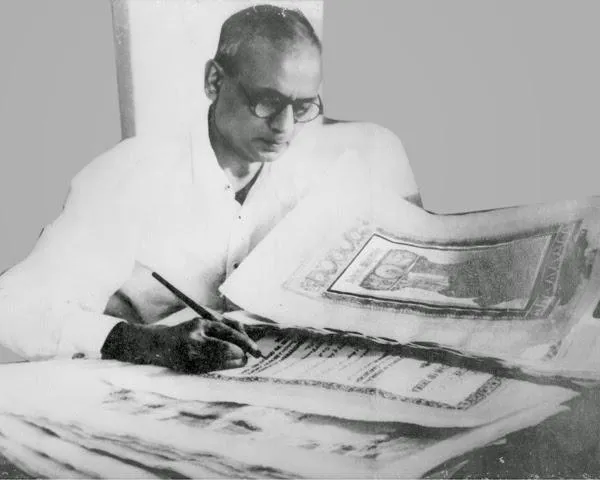
Prem Behari Narain Raizada occupies a special and immortal place in modern Indian history. While countless leaders, freedom fighters, lawmakers, and visionaries contributed to the birth of the Indian Republic, Raizada’s contribution stands apart for its artistic grandeur and cultural significance. He was not a politician, not a constitutional expert, not a member of the Constituent Assembly, nor a public figure involved in debates. Yet his work touches every Indian citizen every single day through the most important document of the nation—the original handwritten Constitution of India. His calligraphy transformed the nation’s founding text into a work of art, blending law with aesthetic beauty, tradition with craftsmanship, and vision with elegance.
Early Life and Background
Prem Behari Narain Raizada was born in 1901 into a Kayastha family in Delhi, a community traditionally associated with writing, documentation, and administration. Calligraphy had been a part of his family heritage for generations. His grandfather, Master Ram Prasad Saxena, was a distinguished calligrapher and played a crucial role in teaching young Prem Behari the foundations of the art. From childhood, Raizada developed a natural affection for beautiful handwriting. The curves, strokes, flow, and balance of letters fascinated him far more than other pursuits. Over time, the craft became his passion and his identity.
He attended St. Stephen’s College, Delhi, one of India’s most prestigious institutions at the time. While he pursued academics, he was equally devoted to refining his calligraphy skills. Unlike modern typographic design, calligraphy required intense discipline. Every stroke demanded precision. A single mistake could ruin an entire page. This intense rigor shaped Raizada’s perfectionist mindset.
Mastery of Calligraphy
Raizada was known for a unique writing style—elegant, flowing, balanced, and distinctly Indian. It incorporated a mix of classical penmanship traditions and personal style. He used a Brahmi-inspired italic hand, giving the letters a stable base while allowing graceful upward strokes. His writing was neither mechanistic nor overly decorative. Instead, it maintained a visual rhythm—a harmony between readability and beauty.
His mastery was such that his handwriting appeared printed, even though every word was drawn by hand with intense care. He practiced for years, mastering control over ink flow, pen pressure, spacing, and alignment. Each letter, word, and paragraph had to be perfectly proportionate.
Calligraphy for him was not merely writing—it was an art form akin to painting, an expression of dedication, patience, and spiritual concentration. This devotion to handwriting would eventually place him in India’s historic journey.
How Raizada Was Chosen to Write the Constitution
By 1947, India had gained independence, and the Constituent Assembly was entrusted with preparing the Constitution. A drafting committee headed by Dr. B.R. Ambedkar compiled the text, but the question of producing a final official version remained. In an era before digital typesetting, manual calligraphy was considered the finest way to present such an important document.
It was Pandit Jawaharlal Nehru, India’s first Prime Minister, who recommended Raizada for this monumental task. Nehru had seen his handwriting and was impressed by its grace. The task demanded not just a calligrapher, but someone with extraordinary precision, patience, and integrity.
When Raizada was approached, he humbly accepted the responsibility. However, when asked what compensation he desired, he responded with a request that became historic:
he wanted no payment, no reward—only the honor of writing his name on every page of the Constitution.
This request was granted, and today, at the bottom of each page of the handwritten Constitution, one finds his signature. It is a subtle but permanent reminder of the artistic soul behind the nation’s foundational text.
The Herculean Task of Writing the Constitution
The work began in 1948 and was completed by late 1950. Raizada worked in a special hall of the Constitution Hall (today part of the Parliament complex). The task was immense and demanded not only artistic mastery but also extreme discipline:
1. Precision of Language
Every word had to be reproduced exactly as approved by the Constituent Assembly. Errors were unacceptable. Even a tiny smudge or ink blot would require rewriting the entire page.
2. Uniformity
Spacing, alignment, stroke weight, and letter shape had to remain consistent across hundreds of pages. It was akin to creating a vast canvas where every section reflected the same style and balance.
3. Ink and Paper Quality
The Constitution was written on high-quality parchment paper. Special ink—produced from powdered soot and gum—was used to ensure longevity. Raizada had to ensure that his strokes did not bleed, fade, or smudge.
4. Physical Endurance
Handwriting a 251-page manuscript demanded extraordinary stamina. Raizada spent months bending over desks, maintaining steady hand movements for hours each day. It required strength, concentration, and emotional steadiness.
5. Aesthetic Integration
Though the content was legal, the presentation had to be beautiful and dignified. His calligraphy would serve as a symbol of India’s cultural heritage. To enhance this artistic expression, the manuscript was later adorned with exquisite illustrations by artist Nandalal Bose and his students from Santiniketan.
Role of Nandalal Bose and Artistic Illustrations
While Raizada wrote the text, Bose and his team added sketches, motifs, and ornamental designs at the margins and opening pages. These illustrations depicted India’s cultural and civilizational heritage—from Mohenjo-Daro seals to scenes of the freedom struggle.
Raizada’s calligraphy and Bose’s artwork together transformed the Constitution from a legal manuscript into a masterpiece of creative expression. Every page echoes harmony: the text flows like poetry, framed by symbolic imagery. This blend of law, culture, and art remains unmatched in any other national constitution.
Completion and Adoption of the Constitution
The calligraphed version of the Constitution was completed shortly before November 26, 1949—the day the Constituent Assembly adopted it. However, it came into force on January 26, 1950, celebrated as Republic Day.
The manuscript was bound into two large volumes, each weighing several kilograms, using gold leaf decoration and high-quality leather covers. Today, the original handwritten Constitution is preserved in a helium-controlled case in the Parliament Library to prevent degradation.
Raizada’s writing forms the core of this iconic artifact. Every word the judiciary interprets, every clause taught to students, every amendment debated—all flow from the script of one man, sitting with his pens and ink nearly eight decades ago.
Legacy and Contribution to India
Prem Behari Narain Raizada’s contribution is unique for several reasons:
1. He gave visual identity to the Constitution
The Indian Constitution is not just a legal document—it is a work of art. Raizada’s handwriting is part of the national heritage.
2. His work symbolizes dedication without material expectation
In an era driven by economic interests, Raizada’s refusal of payment is a powerful reminder of service to the nation out of devotion, not desire.
3. His calligraphy preserves Indian artistic tradition
At a time when the world was moving toward typewriters and machines, Raizada showed the enduring power of handwritten art.
4. He inspired generations of calligraphers
Many artists today cite his work as a benchmark of perfection. His technique and discipline continue to influence handwriting enthusiasts worldwide.
5. His name remains tied to constitutional history
Though not widely known among the general public, scholars and historians deeply respect his role. Each signature at the bottom of every page affirms his presence in the nation’s founding moment.
Personality and Working Style
Accounts from those who observed him describe Raizada as calm, soft-spoken, and dignified. He carried himself with discipline and humility. His dedication to the Constitution was not merely professional; it was spiritual. He believed handwriting carried the writer’s soul, and he approached the task with a sense of sacred responsibility.
He maintained strict routines—specific hours for writing, periods of rest, and time for preparation. Precision ruled his work. Before beginning the actual Constitution pages, he practiced repeatedly on sample sheets to ensure perfect alignment and spacing.
Tools of His Craft
Raizada’s tools were simple yet masterfully used:
- Special reed pens, custom-shaped to control thickness.
- Hand-mixed ink, made with lampblack for durability.
- Parchment paper, chosen for its longevity.
- A wooden desk designed for comfortable posture.
- Guidelines drawn faintly, later erased after the writing dried.
Today, these tools are preserved in historical archives, symbolizing the artisanal roots of modern India.
Why Raizada’s Contribution Feels Timeless
In a digital age, handwritten documents feel rare and nostalgic. Yet the Indian Constitution remains a timeless artifact precisely because of Raizada’s human touch. His artistry reminds the nation that its foundation was crafted not by machines but by human hands—hands skilled in tradition, steeped in emotion, and guided by pride.
The Constitution is often called the “soul of Indian democracy.” If so, then Raizada’s calligraphy is its visible heartbeat.
A National Treasure, Yet a Silent Figure
Despite his monumental contribution, Raizada did not seek fame. His name does not appear in political movements or public speeches. He led a quiet life and passed away in 1966, leaving behind an extraordinary artistic legacy. Only in recent years has public awareness about his role grown significantly. Scholars, teachers, and constitutional experts now emphasize his importance so that future generations understand and appreciate the artistry behind the nation’s most important document.
His work continues to inspire exhibitions, documentaries, and academic discussions on the cultural dimensions of the Indian Constitution.
The Constitution as a Work of Art
Few nations have a constitution whose original text is a piece of art. India stands tall in this regard. The flowing script, the decorated margins, and the powerful legal content come together to produce something deeply symbolic. When dignitaries, students, or researchers view the original manuscript, the first reaction is awe. Many describe the experience as emotional, not just scholarly.
Raizada and Nandalal Bose together ensured that the birth of Indian democracy was not only legal but cultural, civilizational, and artistic. Their work bridges India’s ancient traditions of manuscripts with the modern vision of a democratic republic.
Conclusion
Prem Behari Narain Raizada remains one of the quiet heroes of India’s nation-building era. His work on the Constitution of India reflects a rare combination of artistic mastery, patriotic devotion, and humble service. In the grand narrative of India’s freedom struggle and democratic creation, his contribution may not involve speeches or political debates, but it is no less profound.
Through his calligraphy, he gave visual life to the words of Ambedkar, Nehru, Patel, and countless others. He preserved the dignity of the Constitution through art. And he transformed a national document into a cultural treasure.
Today, as India continues to evolve as the world’s largest democracy, Raizada’s handwriting remains a silent guardian of its constitutional spirit. Every Indian who reads, studies, or refers to the Constitution is, unknowingly, engaging with the gentle strokes of his pen. His legacy serves as a timeless reminder that nation-building is not only done by leaders and lawmakers, but also by artists whose work preserves and beautifies the soul of a nation.
