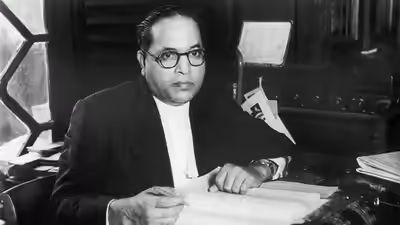
Dr. B. R. Ambedkar was not only the chief architect of the Indian Constitution but also one of the most important economists of modern India. His economic ideas were ahead of their time and focused on creating a nation that was socially just, economically strong, and inclusive. His vision can be understood through themes like industrialization, land reforms, labor welfare, fiscal federalism, and social justice.
One of Ambedkar’s strongest economic beliefs was that India needed rapid industrialization. He argued that agriculture alone could not absorb India’s growing population. According to him, without industrial development, poverty and unemployment would continue. Ambedkar supported state-led industrial growth because the private sector in pre-Independence India lacked the capacity to build heavy industries. As a result, he recommended government-owned industries in sectors like power, mining, and transport. His ideas later influenced India’s public sector policy in the 1950s.
Land reforms were another major concern for Ambedkar. He observed that most Indian farmers were trapped in the cycle of poverty due to small and fragmented landholdings. He proposed the nationalization of land with collective farming. Under his model, land would be owned by the state but managed cooperatively by groups of farmers. Ambedkar believed this would increase productivity, reduce inequality, and promote efficient use of resources. Although his proposal was not fully implemented, it remains one of the most progressive land reform ideas in Indian history.
Ambedkar was also a strong advocate of labor rights. As Labour Member of the Viceroy’s Executive Council from 1942 to 1946, he introduced several laws to protect workers. Some examples include maternity benefit, limited working hours, paid leave, and laws for abolishing forced labor. He supported fair wages and believed that improving worker welfare would increase economic productivity. His contributions laid the foundation for India’s modern labor laws.
Another important economic idea of Ambedkar was the concept of fiscal federalism. He believed that for India to grow, financial powers needed to be balanced between the Centre and the states. As the chairman of the Drafting Committee, he ensured constitutional provisions for Finance Commissions, distribution of taxes, and grants-in-aid. His vision helped create a cooperative and stable financial system between different levels of government.
Ambedkar also emphasized the importance of education and skill development for economic progress. He believed that no nation could grow until its people gained access to knowledge, modern skills, and equal opportunities. For him, education was not just a social reform tool but an economic investment. He argued that empowering disadvantaged communities would increase national productivity and enlarge the economy.
