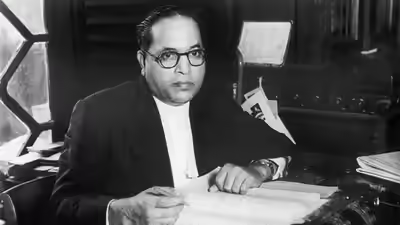
Dr. Bhimrao Ramji Ambedkar, one of India’s most influential intellectuals and social reformers, made historic contributions that shaped modern India. His achievements span law, economics, politics, education, and social justice. Born in 1891 into a marginalized community, Ambedkar rose through extraordinary challenges to become a leading architect of equality and democratic governance.
One of his greatest achievements was his role as the Chief Architect of the Indian Constitution. As the Chairman of the Drafting Committee of the Constituent Assembly, Ambedkar crafted a Constitution that guarantees fundamental rights, equality before the law, and protections against discrimination based on caste, gender, or religion. His vision ensured that the Constitution became a powerful tool to build a democratic, secular, and socially just nation. Ambedkar’s insistence on individual liberty, socio-economic justice, and affirmative action shaped the core principles of India’s legal framework.
Ambedkar was also a pioneering champion of social justice. He led movements against untouchability and fought tirelessly for the rights of Dalits and other oppressed groups. His Temple Entry Movement, Mahad Satyagraha for water rights, and campaigns for equal civic participation challenged centuries-old caste hierarchies. His relentless advocacy contributed to legal reforms that criminalized untouchability and enabled broader social change in independent India.
As a scholar, Ambedkar made groundbreaking contributions to economics. His doctoral work at Columbia University and the London School of Economics explored monetary policy, public finance, and labor welfare. He proposed ideas such as the need for a central bank, which influenced the creation of the Reserve Bank of India. His writings on poverty, land reforms, and industrialization offered early frameworks for India’s economic development. Few leaders of his era matched his academic depth and multidisciplinary thinking.
Ambedkar also served as India’s first Law and Justice Minister. In this role, he worked on reforms to improve the legal system, expand social rights, and protect vulnerable communities. One major attempt was the Hindu Code Bill, which aimed to give women equal rights in marriage, inheritance, and property—an extremely progressive proposal for its time. Though it initially faced resistance, Ambedkar’s ideas later influenced reforms in family law.
A strong believer in education as a tool for transformation, Ambedkar established institutions like the Bahishkrit Hitkarini Sabha, which promoted education and socio-economic advancement for marginalized groups. His personal journey—from facing discrimination in school to earning multiple doctorates—remains an inspiration for millions.
In the final phase of his life, Ambedkar embraced Buddhism and became the leader of a major Buddhist revival in India. His conversion in 1956, along with millions of followers, was an act of social liberation and a rejection of caste oppression. His book The Buddha and His Dhamma reflects his belief in equality, rationality, and compassion.
Dr. Ambedkar’s achievements make him not only a national icon but also a global symbol of justice, dignity, and human rights. His legacy continues to guide India’s pursuit of equality and democracy.
