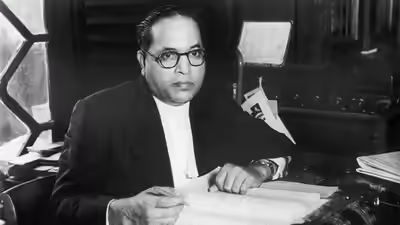
Dr. B. R. Ambedkar at Columbia University
Dr. Bhimrao Ramji Ambedkar, popularly known as Babasaheb Ambedkar, was one of the greatest intellectuals, social reformers, and political leaders of modern India. His education at Columbia University, New York, played a decisive role in shaping his ideas on democracy, social justice, equality, and human rights. Ambedkar’s time at Columbia was not merely an academic phase; it was a period of intellectual awakening that deeply influenced his lifelong struggle against caste discrimination and social inequality in India.
Early Background and Journey to the United States
Born in 1891 into a Dalit family that faced severe social discrimination, Ambedkar experienced caste-based injustice from an early age. Despite these hardships, he showed exceptional academic brilliance. After completing his studies at Bombay University, he received a scholarship from Maharaja Sayajirao Gaekwad of Baroda, which enabled him to pursue higher education abroad.
In 1913, Ambedkar traveled to the United States and enrolled at Columbia University. At that time, Columbia was one of the world’s leading centers of social sciences, economics, and political thought. For Ambedkar, arriving in America was a transformative experience, as it exposed him to a society where legal equality and academic freedom were valued far more than in colonial India.
Academic Life at Columbia University
At Columbia University, Ambedkar studied Economics, Political Science, Sociology, Philosophy, and History. He was deeply influenced by the university’s progressive intellectual environment and its emphasis on empirical research, critical thinking, and social reform.
Some of the most important professors who shaped Ambedkar’s thinking were:
- Professor John Dewey – a philosopher and educationist whose ideas on democracy, pragmatism, and social ethics left a lasting impression on Ambedkar.
- Professor Edwin R. A. Seligman – an economist who guided Ambedkar in economic theory and public finance.
- Professor James Shotwell – a historian who influenced Ambedkar’s understanding of institutions and social change.
Ambedkar later acknowledged that John Dewey’s concept of democracy as a way of life, not merely a form of government, had a profound impact on his political philosophy. This idea later became central to Ambedkar’s vision of Indian democracy.
Scholarly Contributions at Columbia
During his time at Columbia, Ambedkar produced several remarkable academic works. His most famous contribution was his M.A. thesis, titled:
“Ancient Indian Commerce” (1915)
In this work, Ambedkar analyzed India’s trade systems, economic organization, and commercial relations in ancient times, challenging colonial narratives that portrayed India as economically backward.
Later, he completed another significant research paper:
“The National Dividend of India – A Historic and Analytical Study”
This work examined India’s economic structure under British rule and highlighted the unequal distribution of wealth and resources. These early economic studies laid the foundation for Ambedkar’s later critique of colonial exploitation and social inequality.
Ambedkar earned his Master’s degree in Economics in 1915 and continued doctoral-level research at Columbia. His academic excellence earned him respect among his peers and professors, despite racial barriers that existed in early 20th-century America.
Experience of Social Equality in America
One of the most transformative aspects of Ambedkar’s life at Columbia was his experience of social equality. Unlike in India, where caste determined social status, Ambedkar found that in American society, he was treated with dignity as a student and intellectual.
He later wrote that his stay in the United States gave him a sense of self-respect and confidence that had been denied to him in India due to caste discrimination. This experience strengthened his belief that social hierarchies were man-made and could be dismantled through law, education, and democratic values.
Influence on Ambedkar’s Ideas and Future Work
The intellectual training Ambedkar received at Columbia University deeply influenced his later work as:
- The chief architect of the Indian Constitution
- A champion of social justice and fundamental rights
- A thinker who linked political democracy with social and economic democracy
The emphasis on liberty, equality, and fraternity, which Ambedkar later included in the Indian Constitution, clearly reflects the democratic ideals he absorbed during his education in the United States.
His belief that education is the most powerful weapon for social emancipation also matured during his time at Columbia. He realized that knowledge could challenge oppressive traditions and empower marginalized communities.
Recognition by Columbia University
Columbia University continued to honor Ambedkar long after his departure. In 2004, the university formally recognized him as one of its most distinguished alumni. His bust was installed on campus, and his contributions to social justice and constitutional thought were celebrated.
This recognition symbolized the global importance of Ambedkar’s ideas and acknowledged the role Columbia played in nurturing one of the most influential thinkers of the 20th century.
Conclusion
Dr. B. R. Ambedkar’s education at Columbia University was a turning point in his life. It provided him with intellectual tools, democratic values, and personal confidence that shaped his mission to eradicate social inequality in India. The exposure to progressive thought, academic freedom, and social equality strengthened his resolve to fight caste oppression and build an inclusive society.
Ambedkar’s journey from a marginalized background in colonial India to the halls of Columbia University stands as a powerful example of how education can transform not only an individual but an entire nation. His legacy continues to inspire millions, and his time at Columbia remains a crucial chapter in the making of modern India’s most influential social reformer.
