Introduction
Nuclear fusion is one of the most important and powerful processes in the universe. It is the process that powers the Sun and all other stars. Without nuclear fusion, life on Earth would not exist because the Sun would not produce light and heat. Scientists consider nuclear fusion a future source of energy because it can produce enormous power with very little pollution. Nuclear fusion theory explains how light atomic nuclei combine to form heavier nuclei and release a huge amount of energy.
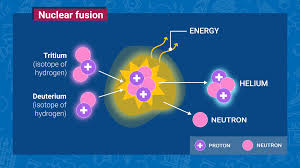
In simple words, nuclear fusion means joining small atoms to make a bigger atom and releasing energy. This theory is based on fundamental principles of physics, especially nuclear physics and Einstein’s famous equation, E = mc².
What is Nuclear Fusion?
Nuclear fusion is a nuclear reaction in which two or more light atomic nuclei combine to form a heavier nucleus. During this process, a large amount of energy is released.
For example, in the Sun:
- Hydrogen atoms fuse together
- They form helium
- Energy is released as heat and light
This released energy travels through space and reaches Earth, making life possible.
Basic Fusion Reaction
The most common fusion reaction studied by scientists is:
Hydrogen + Hydrogen → Helium + Energy
More specifically:
- Deuterium (a type of hydrogen)
- Tritium (another type of hydrogen)
They fuse to form:
- Helium
- A neutron
- A large amount of energy
History of Nuclear Fusion Theory
Early Ideas
In the early 20th century, scientists did not know how the Sun produced energy. Some believed it was burning like coal, but calculations showed that the Sun could not last millions of years that way.
Discovery of Fusion
In the 1920s and 1930s:
- Scientists discovered nuclear reactions
- They realized that mass could be converted into energy
In 1938, Hans Bethe, a German physicist, explained the nuclear fusion processes that occur in stars. He showed how hydrogen turns into helium inside the Sun. For this work, he later won the Nobel Prize.
Einstein’s Role in Nuclear Fusion
Albert Einstein’s equation:
E = mc²
This equation means:
- E = Energy
- m = Mass
- c = Speed of light
According to this equation, a very small amount of mass can be converted into a very large amount of energy.
In nuclear fusion:
- The mass of the final nucleus is slightly less than the total mass of the original nuclei
- This missing mass is converted into energy
This is why nuclear fusion releases so much power.
Conditions Required for Nuclear Fusion
Fusion is not easy to achieve. Atoms naturally repel each other because their nuclei are positively charged. To force them to fuse, extreme conditions are needed.
1. Extremely High Temperature
- Temperature must be millions of degrees Celsius
- In the Sun, the temperature is about 15 million°C
- High temperature gives nuclei enough energy to overcome repulsion
2. High Pressure
- High pressure pushes nuclei close together
- In stars, gravity provides this pressure
3. High Density and Confinement Time
- Particles must stay close long enough to fuse
- This is called plasma confinement
Nuclear Fusion in Stars
Fusion in the Sun
The Sun uses a process called the proton-proton chain reaction:
- Hydrogen nuclei collide
- They form deuterium
- More reactions occur
- Helium is formed
- Energy is released
This process:
- Produces light and heat
- Keeps the Sun stable
- Has been happening for billions of years
Fusion in Bigger Stars
Larger stars use different fusion reactions:
- Hydrogen → Helium
- Helium → Carbon
- Carbon → Oxygen
- And so on
Heavier elements like iron are formed in massive stars.
Artificial Nuclear Fusion on Earth
Scientists want to create fusion on Earth to produce clean energy. This is called controlled nuclear fusion.
Why Fusion on Earth is Difficult
- Extremely high temperatures are required
- No solid material can touch fusion plasma
- Plasma must be controlled carefully
Despite these challenges, scientists continue research because fusion has great advantages.
Methods of Achieving Nuclear Fusion
1. Magnetic Confinement Fusion
This method uses strong magnetic fields to control hot plasma.
Tokamak
- A donut-shaped machine
- Uses powerful magnets
- Plasma is confined in a circular path
Examples:
- ITER (International Thermonuclear Experimental Reactor)
- Located in France
Stellarator
- Similar to tokamak
- More complex magnetic design
- More stable plasma
2. Inertial Confinement Fusion
This method uses lasers.
Process:
- Tiny fuel pellets of hydrogen are used
- Powerful lasers hit the pellet
- The pellet compresses and heats rapidly
- Fusion occurs for a short time
Example:
- National Ignition Facility (USA)
Nuclear Fusion vs Nuclear Fission
| Nuclear Fusion | Nuclear Fission |
|---|---|
| Combines light nuclei | Splits heavy nuclei |
| Uses hydrogen | Uses uranium or plutonium |
| Very little waste | Produces radioactive waste |
| Safer | Risk of meltdown |
| Difficult to control | Already used in power plants |
Advantages of Nuclear Fusion
1. Clean Energy
- No greenhouse gases
- No air pollution
- Helps fight climate change
2. Unlimited Fuel
- Hydrogen is abundant
- Deuterium can be extracted from seawater
3. Safe Process
- No chain reaction
- If conditions fail, fusion stops automatically
4. High Energy Output
- Produces more energy than fossil fuels
- Small fuel amount gives huge power
Disadvantages and Challenges
1. Extremely Expensive
- Fusion reactors cost billions of dollars
- Advanced technology required
2. Technical Difficulties
- Plasma instability
- Material damage due to neutrons
3. Still Experimental
- No commercial fusion power plant yet
- Many years of research still needed
Current Research and Projects
ITER Project
- World’s largest fusion experiment
- International collaboration
- Goal: produce more energy than it consumes
Other Projects
- DEMO (future power plant)
- Private fusion companies
- Research in China, USA, Europe, and Japan
Future of Nuclear Fusion
Scientists believe nuclear fusion could become a major energy source in the future.
Possible future benefits:
- Clean electricity for the world
- Reduced dependence on fossil fuels
- Energy security for all countries
However, experts estimate that commercial fusion energy may take several decades to become fully practical.
Nuclear Fusion and Humanity
If successful, nuclear fusion can:
- Solve global energy problems
- Reduce environmental damage
- Support sustainable development
Fusion energy is often called the “energy of the future.”
Conclusion
Nuclear fusion theory explains one of the most powerful natural processes in the universe. It is the source of energy for stars and has the potential to become a revolutionary energy source for humanity. Although nuclear fusion is extremely difficult to achieve on Earth, continuous scientific research has brought us closer to this goal.
Fusion offers clean, safe, and almost limitless energy. While challenges remain, nuclear fusion represents hope for a sustainable and bright future. Understanding nuclear fusion theory is not only important for physics students but also for anyone interested in the future of energy and the survival of our planet.
