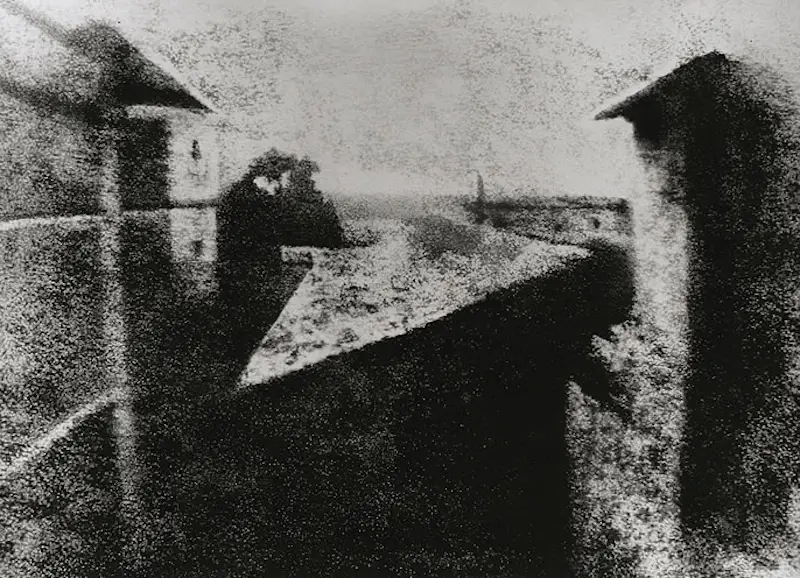
The first photograph ever taken is known as “View from the Window at Le Gras.” It was created in 1826 or 1827 by a French inventor named Joseph Nicéphore Niépce. This photograph is considered one of the most important milestones in the history of science and art because it marked the beginning of photography as we know it today.
Niépce took this photograph from an upstairs window of his country house in Saint-Loup-de-Varennes, France. The image shows a simple rural scene with rooftops, walls, and a courtyard. At first glance, the photograph looks unclear and faded, but its importance lies in the fact that it was the first permanent photographic image ever created.
To make this photograph, Niépce used an early photographic process called heliography. He coated a pewter plate with bitumen of Judea, a natural asphalt that hardens when exposed to light. The plate was then placed inside a camera obscura, a device that projects an image onto a surface. The exposure time was extremely long—about 8 hours or even several days. Because of this long exposure, sunlight appears on both sides of the buildings in the photograph.
After the exposure, Niépce washed the plate with a mixture of oil of lavender and white petroleum. This removed the unhardened bitumen, leaving behind a permanent image. Unlike modern photographs, this image did not use film or paper but was created directly on a metal plate.
The first photograph did not receive much attention during Niépce’s lifetime. However, its value was later recognized, especially after photography developed rapidly in the 19th century. Today, the original photograph is preserved at the Harry Ransom Center at the University of Texas, USA.
The invention of the first photograph changed the way humans record history. Before photography, people depended on paintings or drawings to capture images of the world. Photography made it possible to record reality accurately and objectively. It later influenced journalism, science, art, and everyday life.
In conclusion, the first photograph by Joseph Nicéphore Niépce was a revolutionary achievement. Though simple in appearance, it opened the door to a new era of visual communication and permanently changed how we see and document the world.
