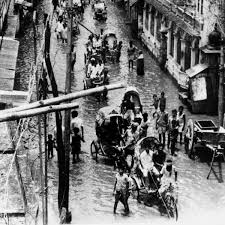

The 1931 China Floods are widely regarded as one of the deadliest natural disasters in human history. Occurring mainly along the Yangtze River, Huai River, and Yellow River basins, these floods devastated vast areas of central and eastern China. The catastrophe unfolded during a period when China was already struggling with political instability, economic hardship, weak infrastructure, and limited disaster-management capacity. As a result, the floods not only caused immediate destruction but also triggered long-term social, economic, and public health crises.
The disaster was not the result of a single event but rather a combination of unusual climatic conditions, environmental degradation, and human vulnerability. The floods of 1931 serve as a powerful historical lesson on how natural hazards can turn into large-scale human tragedies when societies are unprepared.
Background: China Before the Floods
In the early 20th century, China was facing severe internal challenges. The fall of the Qing Dynasty in 1911 had led to political fragmentation, warlordism, and weak central authority. The Nationalist government was still consolidating power, and many regions were governed locally with limited coordination.
Most of China’s population depended on agriculture, living close to rivers for fertile land and water access. Over centuries, extensive deforestation in upstream regions had reduced the land’s ability to absorb rainfall. Riverbanks and dikes, many of which were built using traditional methods, were poorly maintained due to lack of funds and political stability.
These conditions meant that when extreme weather struck, the country was highly vulnerable to disaster.
Climatic Causes of the 1931 Floods
The floods of 1931 were the result of a rare and destructive combination of climatic events. Between 1928 and 1930, China experienced a prolonged drought. The dry period hardened the soil, reducing its ability to absorb water when rainfall returned.
In the winter of 1930–1931, unusually heavy snowfall accumulated in mountainous regions. When spring arrived, rapid snowmelt significantly increased river levels. This was followed by exceptionally heavy monsoon rains in the summer of 1931. In addition, a series of powerful cyclones struck eastern China, bringing intense rainfall over short periods.
By July and August, rivers such as the Yangtze overflowed far beyond their banks. In some areas, water levels remained high for weeks or even months, creating widespread and prolonged flooding.
Scale and Geographic Spread of the Disaster
The 1931 floods affected an estimated area of more than 180,000 square kilometers. Provinces such as Hubei, Hunan, Anhui, Jiangsu, Zhejiang, and Jiangxi were among the worst hit. Major cities, including Wuhan, Nanjing, and Hankou, were submerged or partially flooded.
Wuhan, located at the confluence of the Yangtze and Han rivers, became one of the most affected urban centers. Water levels rose so high that large parts of the city turned into a temporary lake. Transportation, communication, and trade were completely disrupted.
Rural areas suffered even more severely. Entire villages were washed away, farmland was submerged, and millions of people were forced to flee their homes.
Human Impact and Death Toll
Estimating the exact number of deaths caused by the 1931 China Floods is extremely difficult. Contemporary records were incomplete, and many deaths occurred indirectly. Most historians estimate that between 1 million and 4 million people lost their lives, making it possibly the deadliest natural disaster ever recorded.
Importantly, a large proportion of deaths did not occur due to drowning. Instead, famine, disease, and exposure played a major role. Floodwaters destroyed crops just before harvest season, leading to severe food shortages. Malnutrition weakened the population, making them more vulnerable to illnesses.
Diseases such as cholera, dysentery, typhoid, and malaria spread rapidly in stagnant water and overcrowded refugee camps. With limited access to medical care, these outbreaks claimed countless lives.
Economic and Agricultural Consequences
Agriculture was the backbone of China’s economy in 1931, and the floods struck at its very foundation. Millions of hectares of farmland were submerged. Rice paddies, wheat fields, and vegetable crops were destroyed, and livestock drowned in large numbers.
The loss of crops caused food prices to skyrocket. Many families sold their possessions or land just to survive. In some regions, desperate people resorted to eating tree bark, wild plants, or soil mixed with grain husks.
Trade and industry also suffered. Railways were damaged, roads were washed away, and river transport became dangerous or impossible. Factories in flooded cities shut down, leading to unemployment and further economic hardship.
Social Breakdown and Human Suffering
The floods led to massive population displacement. An estimated 50 million people were affected in some way, and millions became refugees. Temporary shelters were overcrowded and lacked basic sanitation.
Family structures were torn apart as people fled in different directions. Many children were orphaned, and cases of human trafficking increased as desperate parents sold their children to survive.
Social order broke down in some areas. Looting and crime increased as food and resources became scarce. Local authorities, overwhelmed by the scale of the disaster, often struggled to maintain control.
Government and International Response
The Nationalist government attempted to respond, but its efforts were limited by poor infrastructure, lack of funds, and political instability. Relief efforts included distributing food, setting up refugee camps, and attempting to repair damaged dikes.
International organizations and foreign governments also provided assistance. The League of Nations played a role in coordinating relief efforts, and charities from the United States, Europe, and Japan sent food, medical supplies, and financial aid.
Despite these efforts, the sheer scale of the disaster meant that relief was insufficient for many. Delays in aid distribution and corruption further reduced the effectiveness of assistance.
Long-Term Effects and Policy Changes
The 1931 floods had lasting impacts on China’s approach to disaster management and river control. The catastrophe highlighted the urgent need for modern flood-control systems, improved meteorological forecasting, and coordinated emergency response mechanisms.
In later decades, especially after the establishment of the People’s Republic of China in 1949, the government invested heavily in large-scale water management projects. Dams, reservoirs, and reinforced levees were constructed along major rivers. While these projects brought their own environmental and social challenges, they were partly motivated by memories of disasters like the 1931 floods.
The floods also influenced public health policy. Greater attention was given to disease prevention, sanitation, and rural healthcare, recognizing the deadly link between natural disasters and epidemics.
Historical Significance
The 1931 China Floods stand as a tragic reminder of the interaction between natural forces and human vulnerability. While extreme weather triggered the disaster, factors such as poverty, environmental degradation, and weak governance turned it into a humanitarian catastrophe.
Historians often use the 1931 floods as a case study to show that disasters are not purely natural events. Instead, they are shaped by social, economic, and political conditions. The same level of rainfall in a more prepared society might have caused far less suffering.
Lessons for the Modern World
In the context of modern climate change, the lessons of the 1931 China Floods are more relevant than ever. Rising global temperatures are increasing the frequency and intensity of extreme weather events, including floods.
The disaster teaches the importance of:
- Sustainable environmental management, such as preventing deforestation
- Strong and well-maintained infrastructure
- Effective early-warning systems
- Transparent and coordinated disaster response
- Public health preparedness
By learning from past tragedies, societies can reduce the risk that natural hazards turn into large-scale human disasters.
Conclusion
The 1931 China Floods were not only one of the deadliest disasters in history but also one of the most complex. Caused by a combination of extreme weather, environmental damage, and social vulnerability, the floods devastated millions of lives and reshaped China’s approach to disaster management.
Remembering the 1931 floods is important not just to honor the victims, but also to remind humanity of its responsibility to prepare for and adapt to nature’s power. History shows that while floods may be unavoidable, the scale of human suffering they cause does not have to be.
