Introduction
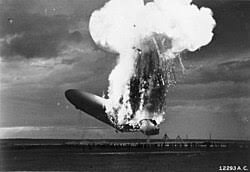
The Hindenburg Airship Disaster is one of the most famous and tragic accidents in the history of aviation. It occurred on 6 May 1937 in Lakehurst, New Jersey, USA, when the German passenger airship LZ-129 Hindenburg caught fire and was destroyed while attempting to land. The disaster resulted in the deaths of 36 people and effectively marked the end of the era of passenger airships.
The Hindenburg was not just a mode of transportation; it was a symbol of technological pride, luxury, and national prestige for Nazi Germany. Its sudden destruction shocked the world, was widely covered by newspapers, photographs, and radio broadcasts, and deeply affected public trust in airship travel.
This disaster remains historically important because it represents a turning point in aviation history, shifting global focus from lighter-than-air travel to heavier-than-air airplanes, which soon became the dominant form of air transportation.
Background: The Age of Airships
Early Development of Airships
Airships, also known as dirigibles, were lighter-than-air aircraft that used gases such as hydrogen or helium to stay aloft. Unlike hot-air balloons, airships could be steered and powered by engines, making them useful for long-distance travel.
In the early 20th century:
- Airships were considered safer and more comfortable than airplanes
- They could travel long distances without refueling
- They offered luxurious passenger experiences
Germany and Zeppelin Technology
Germany was the world leader in airship technology. The most famous German airships were called Zeppelins, named after Count Ferdinand von Zeppelin, who pioneered rigid airship design.
By the 1920s and 1930s:
- Zeppelin airships crossed the Atlantic Ocean
- They carried passengers, mail, and cargo
- They were seen as the future of global travel
The Hindenburg: Design and Purpose
Construction of LZ-129 Hindenburg
The Hindenburg, officially named LZ-129 Hindenburg, was the largest flying machine ever built at the time.
Key features:
- Length: 245 meters (804 feet)
- Diameter: 41 meters
- Gas capacity: 200,000 cubic meters
- Passenger capacity: up to 72
- Crew: 61 members
The airship was built by the Luftschiffbau Zeppelin Company in Germany and first flew in 1936.
Luxury and Comfort
The Hindenburg was designed to offer luxury travel, similar to an ocean liner:
- Private cabins
- A dining room with fine meals
- A lounge with a piano
- Observation windows
- Smoking room (ironically allowed despite hydrogen use)
Passengers often described the experience as smooth, quiet, and elegant.
Use of Hydrogen Gas
Why Hydrogen Was Used
Hydrogen is:
- Very light
- Highly flammable
Although helium is much safer, it was rare and controlled by the United States at the time. Due to political tensions and export restrictions:
- The U.S. refused to sell helium to Nazi Germany
- Germany had no choice but to use hydrogen
This decision played a critical role in the disaster.
Political Significance of the Hindenburg
The Hindenburg was not just a civilian aircraft—it was also a propaganda tool for Nazi Germany.
- The airship often displayed swastika symbols
- It was used to promote German technological superiority
- It participated in political events and airshows
Thus, its destruction was also a symbolic blow to Nazi prestige.
The Final Flight: Timeline of Events
Departure from Germany
- Date: 3 May 1937
- Location: Frankfurt, Germany
- Destination: Lakehurst Naval Air Station, New Jersey
On board:
- 36 passengers
- 61 crew members
The flight across the Atlantic took approximately four days.
Weather Conditions
When the Hindenburg arrived near Lakehurst on 6 May 1937:
- Weather was unstable
- There were thunderstorms
- Strong winds delayed landing
The airship circled the area for several hours before receiving clearance to land.
The Disaster: What Happened?
The Moment of Ignition
At approximately 7:25 PM, as the Hindenburg was descending:
- A small flame appeared near the rear
- Within seconds, fire spread rapidly
- The hydrogen ignited explosively
The entire airship was engulfed in flames in less than 40 seconds.
Casualties
Out of 97 people on board:
- 35 died
- 1 ground crew member died
- 62 survived
Many survivors escaped by:
- Jumping from low heights
- Falling with the collapsing structure
Despite the massive fire, the survival rate was higher than initially expected.
Eyewitness Accounts and Media Coverage
Radio Broadcast
The disaster became famous partly because it was recorded live by radio reporter Herbert Morrison.
His emotional reaction, including the famous words:
“Oh, the humanity!”
became one of the most iconic moments in broadcast history.
Photographs and Film
- Several photographers captured the disaster
- Newsreels showed the burning airship worldwide
- Images shocked the public
This was one of the first global media disasters.
Possible Causes of the Fire
Hydrogen Ignition Theory
The most widely accepted explanation:
- Hydrogen gas leaked
- Static electricity ignited the gas
- The fire spread instantly
Hydrogen burns extremely fast, explaining the speed of destruction.
Static Electricity and Weather
Contributing factors:
- Stormy weather
- Static charge buildup
- Wet landing lines
These conditions may have triggered a spark.
Sabotage Theories (Debunked)
Some early theories suggested:
- Bomb sabotage
- Political conspiracy
However:
- No solid evidence was found
- Investigations dismissed sabotage claims
Official Investigations
Both German and American authorities conducted investigations.
Findings:
- Structural failure may have caused gas leakage
- Weather conditions increased risk
- Hydrogen was the main hazard
The disaster was ruled an accidental fire, not an attack.
Impact on Aviation History
End of Passenger Airships
After the disaster:
- Public confidence collapsed
- Airship travel declined rapidly
- Commercial Zeppelin flights ended
Within a few years:
- Airships were retired
- Airports expanded airplane use
Rise of Airplanes
The disaster accelerated:
- Investment in airplanes
- Development of safer aircraft
- Expansion of commercial aviation
By the 1940s:
- Airplanes dominated long-distance travel
Cultural and Historical Legacy
In Media and Education
The Hindenburg disaster appears in:
- History textbooks
- Documentaries
- Films
- Aviation museums
It is often used as:
- A lesson in engineering safety
- A case study in risk management
Symbolism
The disaster symbolizes:
- The dangers of ignoring safety
- The limits of technological pride
- The role of politics in science
Lessons Learned
Key lessons include:
- Safety must override ambition
- Material choice is critical in engineering
- Media can shape public perception
- Political decisions can affect technological outcomes
Modern Perspective
Today, airships still exist:
- Used for advertising
- Surveillance
- Scientific research
However:
- Hydrogen is rarely used
- Helium and advanced materials ensure safety
The Hindenburg disaster remains a warning from history.
