Bhagat Singh, one of India’s most iconic revolutionaries, occupies a unique place in the nation’s struggle for independence. His courage, clarity of thought, intellectual depth, and absolute commitment to freedom turned him into a symbol of resistance against imperialism. Although his life lasted only twenty-three years, his ideas, writings, and martyrdom left a profound and lasting impact on generations. This biography explores Bhagat Singh’s life from childhood to martyrdom, along with his ideology, political evolution, major actions, trial, execution, and legacy.
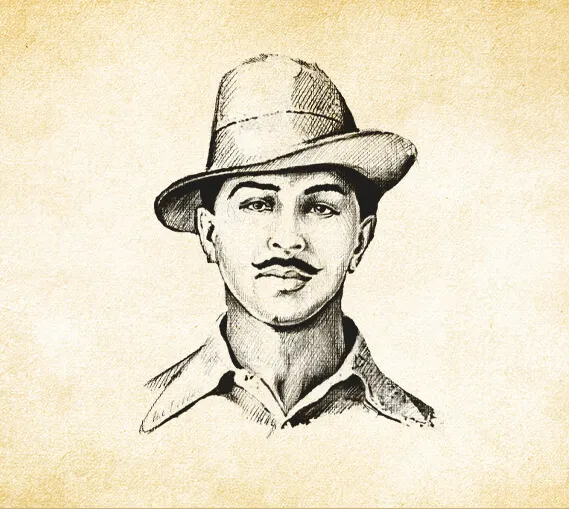
1. Early Life and Background
Bhagat Singh was born on 28 September 1907 in the village of Banga in the Lyallpur district of Punjab (now in Pakistan). His family was deeply involved in the freedom struggle. On the day he was born, his father Kishan Singh and uncles Ajit Singh and Swaran Singh were released from jail. This coincidence gave his birth a symbolic connection to the fight against British rule.
The Singh family belonged to the Arya Samaj reformist tradition, which encouraged social reform, nationalism, and resistance to injustice. Young Bhagat grew up listening to stories of heroic resistance and patriotic sacrifices. His uncle Ajit Singh, a major figure in the early nationalist movement, founded the Bharat Mata Society and led farmers’ protests against unjust colonial laws like the Punjab Colonization Act. Living in such an atmosphere shaped Bhagat Singh’s personality from childhood.
2. Childhood Influences and Early Rebellion
From an early age, Bhagat Singh demonstrated unusual intelligence, curiosity, and moral courage. He was inspired by the Jallianwala Bagh Massacre of 1919, which occurred when he was just 12 years old. The brutal killing of innocent civilians by General Dyer shook him deeply. The day after the massacre, he went to the site, collected blood-soaked soil in a bottle, and kept it as a sacred reminder of colonial brutality.
He studied at the National College, Lahore, founded by Lala Lajpat Rai. The institution encouraged critical thinking and nationalist ideas. Instead of following traditional career paths, Bhagat Singh devoted himself entirely to learning revolutionary politics, history, philosophy, and the struggle movements worldwide.
By the age of 14, he had already participated in protests against the Non-Cooperation Movement’s withdrawal by Mahatma Gandhi. While he respected Gandhi’s moral authority, he disagreed with the strategy of non-violence as the sole path to freedom. This disagreement eventually pushed him towards more radical movements.
3. Joining Revolutionary Organisations
During his teenage years, Bhagat Singh secretly joined the revolutionary groups forming across northern India. He became a member of the Naujawan Bharat Sabha, an organisation that aimed to unite young Indians against colonial rule and promote secularism, socialism, and nationalism.
Later, he joined the Hindustan Republican Association (HRA), founded by Ram Prasad Bismil, Ashfaqulla Khan, and others. After the arrests and executions following the Kakori Conspiracy Case of 1925, the organisation weakened but did not vanish. Under young revolutionaries like Bhagat Singh, Chandrashekhar Azad, Batukeshwar Dutt, and Bhagwati Charan Vohra, it reorganized and evolved into the Hindustan Socialist Republican Association (HSRA).
HSRA’s goal was not only to overthrow British rule but also to establish a socialist republic based on equality, justice, and human dignity.
4. The Turning Point: Lala Lajpat Rai’s Death
In 1928, the British government appointed the Simon Commission to propose constitutional reforms. The Commission included no Indian member, leading to widespread protests under the slogan “Simon Go Back!”
Lala Lajpat Rai led a major protest march in Lahore. The British police, under Superintendent James A. Scott, brutally lathi-charged the peaceful protestors. Lala Lajpat Rai suffered fatal injuries and died a few weeks later.
This incident deeply angered Bhagat Singh and his comrades. Although Rai had supported non-violence, his death stirred revolutionary anger across India. Bhagat Singh, Rajguru, and Sukhdev vowed to avenge his death.
On 17 December 1928, they attempted to kill James Scott but mistakenly shot John Saunders, a British police officer.
The incident marked Bhagat Singh’s full emergence as a revolutionary leader. He shaved his beard and cut his hair—an extremely difficult decision for a Sikh raised in a traditional family—so he could avoid recognition. This sacrifice shows his dedication to the cause.
5. Evolution of Ideology: From Nationalism to Revolutionary Socialism
Bhagat Singh’s thought process evolved with time. During his early years, he was inspired by traditional patriotism, Sikh heroes, and Indian freedom fighters. But as he read more widely, his intellectual views broadened.
He studied:
- Marxism and socialist writings
- The French and Russian revolutions
- Irish freedom struggles
- Italian anti-fascist movements
- Political philosophy and world history
He became convinced that political independence alone was not enough; India needed a deeper social transformation.
Bhagat Singh believed in:
- Ending caste discrimination
- Removing economic inequality
- Promoting secularism
- Ending feudalism and landlordism
- Empowering workers and peasants
- Scientific thinking instead of blind faith
He famously wrote, “Revolution is not bombs and pistols. It is the spirit of freedom, equality, and justice.”
6. The Central Legislative Assembly Bombing (1929)
To protest against two repressive laws—the Public Safety Bill and Trade Disputes Bill—HSRA decided to make a dramatic but non-violent statement in the Central Legislative Assembly in Delhi.
The plan was not to kill anyone but to make the “deaf British government hear the voice of Indians.”
On 8 April 1929, Bhagat Singh and Batukeshwar Dutt entered the Assembly. As the bills were being discussed, they threw two low-intensity bombs in empty areas, followed by leaflets declaring their revolutionary message. After the smoke cleared, they shouted:
“Inquilab Zindabad!”
“Down with Imperialism!”
They made no attempt to escape. Instead, they stood there, offered themselves for arrest, and used the trial as a platform to spread their ideas. This episode made Bhagat Singh a national hero almost overnight.
7. The Trial and the Public Sympathy
The Assembly Bomb Case was followed by the Saunders Case trial, known as the Lahore Conspiracy Case. The British government attempted to portray the revolutionaries as violent criminals. But Bhagat Singh transformed the courtroom into a political stage.
He wrote articles, gave statements, read historical arguments, and explained how colonialism was based on exploitation. His calm, educated, and eloquent speeches impressed even his critics.
He argued that:
- The British had no moral right to rule India
- Violence was a reaction to the violence of colonialism
- Revolutionaries aimed to create a just society
- The Indian masses had the right to resist oppression
Newspapers across India published his statements, making him widely admired.
8. The Historic Hunger Strike
In jail, Bhagat Singh launched a hunger strike demanding equal treatment for Indian political prisoners compared to European prisoners. Their demands included:
- hygienic food
- access to books and newspapers
- proper clothing
- opportunities for exercise
- fair treatment
The hunger strike lasted for over two months. It became a national sensation. Citizens held mass rallies, students left classrooms, and people across India fasted in solidarity.
During the strike, Jatin Das, one of the revolutionaries, died after 63 days of fasting. His martyrdom deeply angered the nation.
The hunger strike demonstrated Bhagat Singh’s incredible willpower and moral strength. He proved that revolutionaries could fight even without weapons.
9. Martyrdom: Execution on 23 March 1931
Despite growing public support, the British government was determined to crush the revolutionary movement. The tribunal sentenced Bhagat Singh, Rajguru, and Sukhdev to death.
Their execution was originally scheduled for 24 March 1931, but the government advanced it secretly to the night of 23 March, fearing public uprising.
On the day of execution, Bhagat Singh was reading Lenin’s biography. When the jail authorities came to take him to the gallows, he smiled and said:
“Wait a moment. A revolutionary is meeting another revolutionary.”
The three revolutionaries walked to the gallows with extraordinary calm and courage. Their last words were:
“Inquilab Zindabad!”
Their bodies were secretly cremated near the Sutlej River, but people soon discovered the site, recovered the ashes, and honored them.
Bhagat Singh was only 23 years old.
10. Legacy and Impact on India’s Freedom Struggle
Bhagat Singh’s influence spread rapidly after his death. He became a national symbol of courage and an inspiration for millions. His martyrdom infused new energy into the freedom movement.
a. Inspiration to Youth
Generations of young Indians embraced his ideals of courage, sacrifice, and dedication. Schools, colleges, and youth organisations celebrated him as the face of fearless resistance.
b. Influence on Political Thought
His writings introduced Indians to:
- socialism
- scientific thinking
- secular democratic values
- revolutionary nationalism
His essay “Why I Am an Atheist” remains one of the most studied political writings in modern Indian history.
c. His Vision for India
Bhagat Singh dreamt of:
- an India free from British rule
- a society without class or caste oppression
- equal rights for all communities
- freedom of speech and expression
- economic equality
- education for all
- dignity for workers and farmers
He wanted not just political freedom but social and economic justice.
d. Cultural Influence
He became a household figure through:
- literature
- songs
- theatre
- films
- poetry
Poets like Ram Prasad Bismil, Shahid Azmi, and others wrote inspiring verses about him. Movies like Shaheed (1965), The Legend of Bhagat Singh (2002), and several documentaries brought his life to the screen.
11. Ideological Brilliance: The Thinker Behind the Revolutionary
Although many remember him only for his radical actions, Bhagat Singh was also a deep thinker. He wrote extensively on:
- capitalism
- colonialism
- communalism
- caste
- gender equality
- education
- democracy
- the role of the state
He believed that blind faith and superstition weakened society. He urged Indians to adopt reason, science, and rationality. In his writings, he often argued that India needed not just freedom from the British but a transformation of social structures.
12. Bhagat Singh’s Relevance in the 21st Century
Even today, Bhagat Singh’s words and ideas remain extremely relevant. India continues to face issues like inequality, communal tension, caste discrimination, corruption, and exploitation. His dream of a socialist, secular, and just society is still far from complete.
Modern discussions around freedom, democracy, dissent, and rights often refer to his writings. His idea of patriotism was not limited to slogans; it was tied to improving society and uplifting the poor.
He believed:
“Patriotism means fighting against every form of injustice.”
This makes him not only a historical figure but also a guiding light for present and future generations.
13. Conclusion
Bhagat Singh’s life, though brief, was extraordinary in its intensity and purpose. He represented the spirit of youth, the power of ideas, and the courage to challenge injustice. His story is not merely about one revolutionary; it is about the aspirations of a nation longing for dignity and freedom.
He was a freedom fighter, philosopher, writer, and visionary whose sacrifices shaped India’s history. His martyrdom on 23 March 1931 transformed him into a timeless symbol of resistance. Today, Bhagat Singh stands not only as a hero of India but as a global icon of revolutionary integrity.
His message continues to inspire millions to fight for justice, equality, and freedom—not just from foreign rule, but from every form of oppression.
Bhagat Singh once wrote:
“They may kill me, but they cannot kill my ideas.”
Indeed, his ideas live on, powerful and eternal.
