Introduction
The Black Death was one of the deadliest pandemics in human history. It swept across Europe, Asia, and parts of Africa between 1347 and 1351, killing an estimated 75 to 200 million people. In Europe alone, nearly one-third to one-half of the population died within just a few years. The disease did not only destroy lives; it deeply transformed society, economy, religion, culture, and the way people understood health and disease. The Black Death became a turning point in medieval history, marking the end of an era and the beginning of profound social change.
The term “Black Death” was not commonly used during the pandemic itself. Medieval people often called it the “Great Mortality” or the “Great Plague.” The name “Black Death” became popular much later, possibly referring to the dark skin discolorations caused by the disease or symbolizing the fear and death it brought. Understanding the Black Death helps us understand how vulnerable human societies are to disease and how crises can reshape the world.
Origins of the Black Death
The Black Death is believed to have originated in Central Asia, although some historians argue for China as its starting point. The disease was caused by the bacterium Yersinia pestis, which primarily lived in rodents, especially rats. Fleas feeding on infected rats became carriers of the bacteria. When these fleas bit humans, they transmitted the infection.
Trade routes played a crucial role in spreading the plague. The Silk Road connected Asia, the Middle East, and Europe, allowing goods, people, and unfortunately diseases to travel vast distances. By the early 1340s, the plague had reached regions near the Black Sea. In 1347, Genoese traders fleeing the besieged port city of Kaffa (in present-day Crimea) carried the disease to Mediterranean ports such as Messina, Venice, and Genoa. From there, the plague spread rapidly throughout Europe.
Spread Across Europe
Once the Black Death entered Europe, it moved with terrifying speed. Medieval cities were crowded, dirty, and poorly ventilated, making them ideal environments for disease transmission. People lived close to animals, waste disposal systems were primitive, and clean water was scarce.
From Italy, the plague spread northward to France and Spain, then eastward to the Holy Roman Empire and England. By 1348, it had reached Paris and London. Scandinavia and Eastern Europe followed soon after. By 1351, most of Europe had experienced the devastating effects of the plague.
Maritime trade and land routes both contributed to its spread. Ships carried infected rats and fleas from port to port, while merchants, pilgrims, and soldiers unknowingly transported the disease along roads and pathways. Isolation was rare, and there were no effective quarantine systems at the beginning, which allowed the disease to move unchecked.
Forms of the Plague
The Black Death appeared in three main forms, each with different symptoms and levels of fatality:
- Bubonic Plague: This was the most common form. It caused swollen lymph nodes called “buboes,” usually found in the groin, armpits, or neck. Other symptoms included fever, chills, weakness, and severe pain. Death often occurred within a few days.
- Pneumonic Plague: This form infected the lungs and could spread directly from person to person through coughing. Symptoms included difficulty breathing, chest pain, and bloody cough. Pneumonic plague was highly contagious and almost always fatal without treatment.
- Septicemic Plague: This form infected the bloodstream. Victims suffered from fever, extreme weakness, and internal bleeding, which caused the skin to turn black or purple. Death could occur within hours.
These forms made the Black Death especially deadly, as the disease could spread in multiple ways and kill very quickly.
Medical Knowledge and Responses
Medical knowledge in the 14th century was extremely limited. Most doctors relied on ancient theories, especially the idea of the four bodily humors: blood, phlegm, black bile, and yellow bile. Disease was believed to result from an imbalance of these humors.
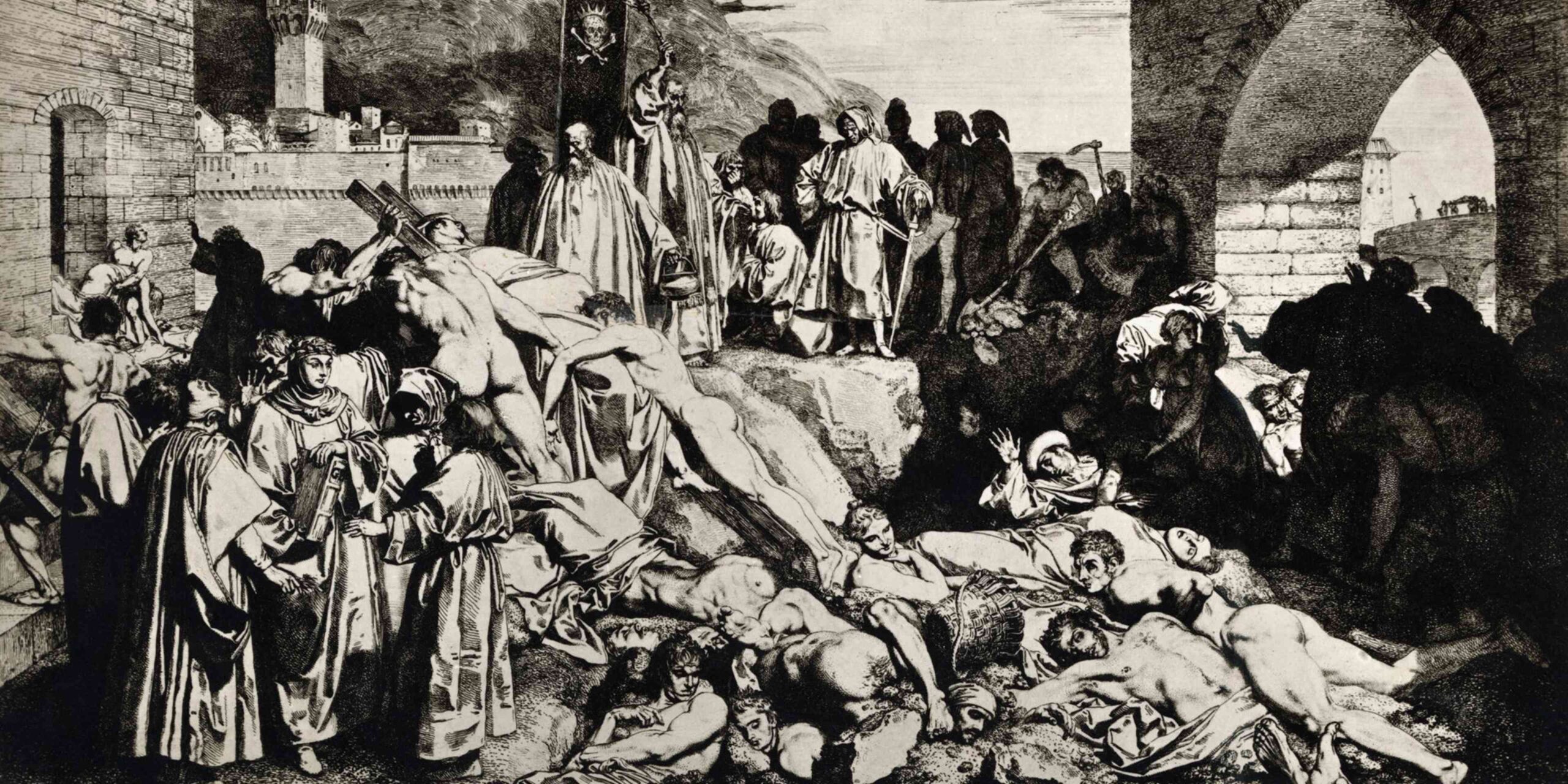
Many people believed the plague was caused by “miasma,” or poisonous air. Others saw it as a punishment from God for human sins. Astrological explanations were also popular, with some blaming planetary alignments.
Treatments were often ineffective or harmful. Doctors prescribed bloodletting, herbal remedies, or the use of charms and prayers. Some advised people to avoid bathing, believing that water opened the pores and allowed disease to enter the body. Protective clothing, such as the famous plague doctor masks filled with herbs, was used, but it offered little real protection.
Religious and Social Reactions
Religion played a central role in how people responded to the Black Death. Many believed the plague was a sign of divine anger. As a result, people prayed intensely, attended religious processions, and sought forgiveness for their sins.
A group known as the Flagellants traveled from town to town, publicly whipping themselves to atone for humanity’s sins. While they believed this would stop the plague, their movements often helped spread the disease further.
Fear and confusion also led to violence. Jewish communities were frequently blamed for poisoning wells and causing the plague. This resulted in widespread persecution, massacres, and expulsions across Europe. These tragic events highlight how fear can lead to injustice and cruelty.
Impact on Daily Life
The Black Death disrupted every aspect of daily life. Entire families died within days. Villages were abandoned, farms were left untended, and cities fell silent. The constant presence of death created a culture of fear and despair.
Burial practices changed dramatically. Cemeteries became overcrowded, and mass graves were common. Traditional funeral rites were often abandoned due to fear of infection.
Art and literature from this period reflect the trauma of the plague. Themes of death, decay, and the fragility of life became common. The concept of memento mori, reminding people of their mortality, gained popularity in paintings, poems, and sermons.
Economic Consequences
One of the most significant effects of the Black Death was its impact on the economy. With a massive loss of population, there was a severe shortage of labor. As a result, surviving workers demanded higher wages and better working conditions.
The feudal system, which depended on a large population of peasants tied to the land, began to weaken. In many regions, serfs gained greater freedom and mobility. Landowners struggled to maintain their estates and were forced to negotiate with workers.
Governments attempted to control wages and prices through laws, such as the English Statute of Labourers in 1351. However, these laws were often ineffective and led to social tensions and uprisings in later years.
Political Effects
The Black Death also affected political structures. Many rulers and officials died, creating instability and power struggles. Governments faced difficulties collecting taxes and maintaining order.
At the same time, the failure of authorities and the Church to prevent or explain the plague led to a decline in trust. People began to question traditional institutions and beliefs. This gradual shift in thinking contributed to the social and intellectual changes that would later lead to the Renaissance.
Long-Term Cultural Impact
The cultural impact of the Black Death lasted for centuries. Literature such as Giovanni Boccaccio’s The Decameron provides vivid descriptions of life during the plague. Music, art, and drama increasingly focused on human emotions and experiences rather than purely religious themes.
The pandemic also influenced medical progress. Although real scientific understanding was still far away, the scale of the disaster encouraged closer observation of disease and public health measures. Quarantine practices, first developed in cities like Venice, became an important tool in later epidemics.
Comparison with Later Pandemics
The Black Death is often compared with later pandemics, such as the Spanish Flu of 1918 or the COVID-19 pandemic. While medical science has advanced greatly, some similarities remain: fear, misinformation, social disruption, and economic challenges.
Studying the Black Death helps us understand the importance of scientific knowledge, public health systems, and social cooperation in managing disease outbreaks.
Conclusion
The Black Death was more than a medical disaster; it was a transformative event in human history. It reshaped Europe’s population, economy, and social structure. It challenged religious beliefs, weakened feudalism, and encouraged new ways of thinking about life and death.
Despite the immense suffering it caused, the Black Death also laid the groundwork for change and renewal. By understanding this pandemic, we gain valuable insight into human resilience and the powerful forces that shape civilizations. The lessons of the Black Death remain relevant today, reminding us of the importance of compassion, knowledge, and preparedness in the face of global crises.
