India’s journey into space science began with a historic moment on 19 April 1975, when the country launched its first satellite, Aryabhata. Named after the ancient Indian mathematician and astronomer Aryabhata (476–550 CE), the satellite represented India’s entry into the global space community. Though small in size compared to modern satellites, Aryabhata carried enormous symbolic, scientific, and technological significance. It became a landmark achievement for the Indian Space Research Organisation (ISRO) and laid the foundation for India’s remarkable future in space exploration.
Background and Need for a Satellite Programme
In the decades after independence, India was still developing its scientific and technological capabilities. Under the leadership of scientists like Dr. Vikram Sarabhai, ISRO was formed in 1969 with a clear vision: to use space science for national development, communication, meteorology, and education. At that time, India lacked experience, infrastructure, and resources for satellite building. Launch facilities were almost nonexistent, and the country relied on foreign technology.
However, Indian scientists were determined to make India self-reliant in space. Aryabhata became the first major step toward mastering satellite design, fabrication, and testing. Even though the launch was carried out from the Soviet Union, the building of the satellite itself was done entirely in India. This helped the country gain confidence in developing indigenous space technologies.
Development of Aryabhata
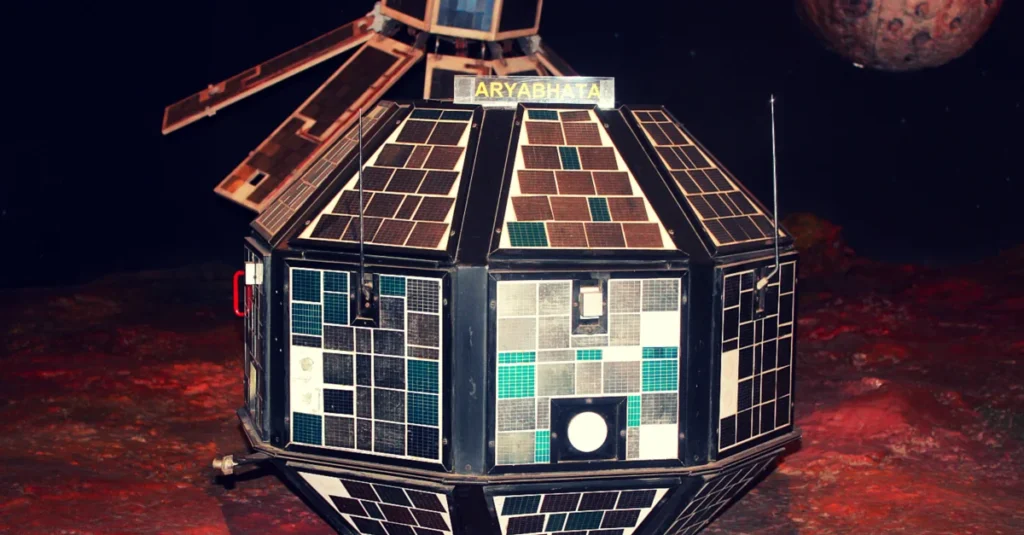
The development of Aryabhata began in the early 1970s. ISRO engineers and scientists worked at the ISRO Satellite Centre (ISAC), Bengaluru—now known as U R Rao Satellite Centre (URSC). The satellite was cube-shaped, measuring approximately 1.2 meters in diameter and weighing around 360 kilograms.
It was designed to carry out scientific experiments, mainly in the fields of:
- X-ray astronomy
- Solar physics
- Aeronomy (study of the upper atmosphere)
For a country with no previous satellite-making experience, designing Aryabhata was a complex task. The satellite required advanced engineering, including solar panel integration, thermal control systems, communication equipment, and electronic circuits. Indian scientists relied on creativity, indigenous knowledge, and limited resources to build a fully functional satellite that could operate in space’s harsh conditions.
Collaboration with the Soviet Union
India did not have its own launch vehicle in 1975. Therefore, ISRO collaborated with the Soviet Union, which provided the launch vehicle and facilities. According to the agreement, the Soviet Union would launch India’s satellite from its Kapustin Yar launch site, while India allowed the Soviets to use certain space-related facilities in India.
This partnership allowed India to:
- Reduce costs
- Receive technical support
- Gain international experience
- Speed up its space programme
Thus, although the launch vehicle was foreign, the satellite represented India’s own scientific strength.
The Launch of Aryabhata
On 19 April 1975, Aryabhata was successfully launched aboard the Kosmos-3M rocket from the Soviet launch site. The satellite was placed into a low Earth orbit at an altitude of around 600 kilometers.
The moment of launch was historic for India. For the first time, the Indian tricolour was associated with a satellite orbiting Earth. The event symbolized technological advancement, scientific maturity, and national pride.
Aryabhata initially worked well, and its systems functioned as expected. ISRO ground stations received signals and data, confirming the satellite’s successful deployment.
Design and Structure
Aryabhata had a distinctive appearance. Unlike modern satellites covered with golden foil, Aryabhata had a black, faceted structure designed to minimize temperature fluctuations in space. Its exterior panels were covered with solar cells that provided power to the satellite. Inside, it contained instruments for scientific experiments, transmitters and receivers for communication, and batteries for backup power.
Some key features included:
- Polygonal (26-faced) shape, which helped thermal control
- Solar panels generating around 46 watts
- On-board power system with nickel-cadmium batteries
- Electronic and communication subsystems for data transmission
It was a small but sophisticated machine for its time.
Scientific Objectives and Experiments
The primary goal of Aryabhata was not commercial communication, but scientific research. Its instruments were designed to study:
1. X-ray Astronomy
Aryabhata carried detectors to observe X-rays emitted by cosmic sources like stars and black holes. This helped Indian scientists gain early experience in space astronomy.
2. Solar Physics
It studied solar emissions, which affect the Earth’s environment, climate, and communication systems.
3. Upper Atmospheric Studies
The satellite’s instruments also measured phenomena in the upper atmosphere, providing valuable data for future missions.
Although some experiments were interrupted due to technical issues, the data collected was still valuable for ISRO.
Technical Challenges and Failure of Power System
A few days after launch, Aryabhata faced a major issue: a power failure caused by a problem in the satellite’s systems. This resulted in the breakdown of communication between the satellite and Earth. As a result:
- Scientific experiments stopped
- Data transmission became difficult
- The mission had to be terminated earlier than expected
Despite the failure, Aryabhata succeeded in achieving its primary goal—demonstrating India’s capability to design and build a satellite.
Impact on India’s Space Programme
Aryabhata marked the beginning of a new era for ISRO. It inspired confidence, encouraged innovation, and built a skilled scientific workforce. The satellite helped India learn critical engineering lessons:
- Designing reliable power systems
- Improving communication technology
- Understanding satellite thermal behavior
- Mastering fabrication techniques
These lessons directly contributed to the success of later satellites such as Bhaskara, Rohini, INSAT, and IRS.
Today, India is known for advanced space missions like Chandrayaan, Mangalyaan, Aditya-L1, and Gaganyaan. The seed for these achievements was planted by Aryabhata.
Legacy of Aryabhata
Aryabhata’s legacy is enormous:
- It was India’s first step in space technology
- It gave ISRO global recognition
- It proved India’s engineering capabilities
- It inspired generations of scientists
- It helped develop indigenous launch vehicles later
Even after decades, Aryabhata remains a symbol of India’s scientific ambition. Its name is often mentioned in textbooks, documentaries, and competitive exams.
Although the satellite stopped functioning long ago, it continued orbiting Earth for years before eventually re-entering the atmosphere.
Conclusion
Aryabhata (1975) stands as a milestone in India’s space journey. It represented courage, vision, and scientific determination at a time when India was still developing as a nation. The satellite may have been small, but its impact was monumental. It gave birth to a new era of technological self-reliance and set India on the path to becoming one of the world’s leading space powers. From building simple satellites to launching interplanetary missions, India’s achievements today trace their roots back to Aryabhata—the humble first satellite that carried India’s dreams into space.
