Utkarsh_bauddh
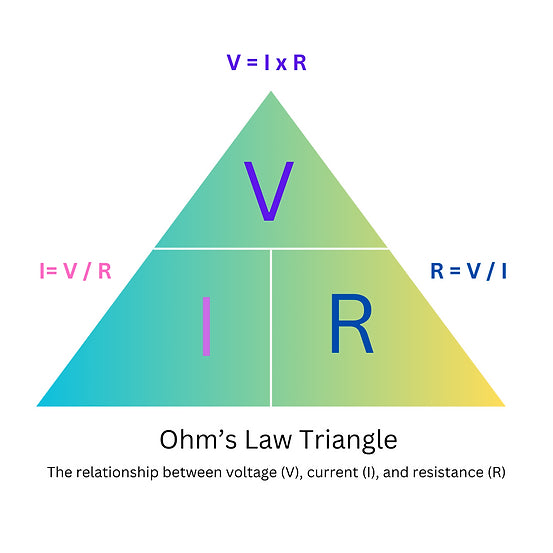
Ohm’s Law is one of the most important rules in electricity. It explains the simple relationship between voltage (V), current (I), and resistance (R) in an electric circuit. This law was given by the German scientist Georg Simon Ohm in 1827. It helps us understand how electrical devices like bulbs, fans, heaters, and chargers work safely and efficiently.
The Basic Statement
Ohm’s Law says:
The current through a conductor is directly proportional to the voltage across it, provided the temperature and other physical conditions remain constant.
In simple form, the law is written as:
Where:
V = Voltage (in volts)
I = Current (in amperes)
R = Resistance (in ohms)
This formula can also be rearranged as:
How It Works in Real Life
Imagine electricity like water flowing through a pipe:
Voltage is like the water pressure that pushes the water.
Current is like the amount of water flowing.
Resistance is like the narrowness of the pipe.
If you increase the voltage, the current increases (if resistance stays the same).
If you increase the resistance, the current decreases (if voltage stays the same).
Example
Suppose a bulb is connected to a 10-volt battery and has a resistance of 5 ohms.
Using Ohm’s Law:
This means 2 A of current flows through the bulb.
If the resistance becomes 10 ohms, then:
Conditions for Ohm’s Law
Ohm’s Law works only when:
The temperature of the conductor is constant
The physical condition of the wire does not change
The material is ohmic (like copper, iron, etc.)
It does not work well for devices like diodes, transistors, and filament lamps, because their resistance changes with temperature.
Importance of Ohm’s Law
Ohm’s Law is used to:
Design electrical circuits
Calculate safe current for devices
Prevent short circuits and overheating
Repair electrical appliances
Conclusion
Ohm’s Law is the foundation of basic electricity. It shows how voltage, current, and resistance depend on each other. By using this simple law, engineers and electricians can build safe and efficient electrical systems

Author: Utkarsh_bauddh
Hello! I am Utkarsh Bauddh.