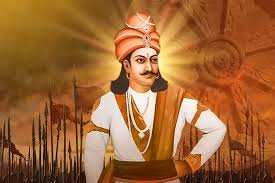
Samrat Ashoka, also known as Ashoka the Great, was one of the most extraordinary rulers in Indian and world history. He governed the Mauryan Empire during the 3rd century BCE and transformed it into one of the largest, richest, and most organized empires ever created in ancient India. His reign is remembered not only for its political success but also for its moral and spiritual legacy, especially after he embraced Buddhism. Ashoka’s life story is a powerful example of how a ruler can change from a fearsome conqueror into a compassionate leader devoted to peace, justice, and welfare of the people.
Early Life and Family Background
Ashoka was born around 304 BCE into the Mauryan dynasty. His grandfather, Chandragupta Maurya, founded the dynasty and built a strong empire with the help of the brilliant strategist Chanakya (also known as Kautilya). Ashoka’s father, Bindusara, continued expanding the empire and kept the administration strong.
Ashoka grew up in a royal environment surrounded by politics, war strategy, and administrative duties. However, his childhood was not easy. He had many brothers, and there was constant competition among them for the throne. Historical accounts suggest that some family members did not like him because he was strong, intelligent, and skilled in warfare. Despite this, Ashoka received excellent training. He learned martial arts, horse riding, archery, military strategies, and statecraft. He also developed a sharp understanding of justice and governance.
As he grew older, Ashoka showed remarkable bravery. He was often sent to difficult regions where rebellions were common. In every mission, Ashoka displayed courage and efficiency. These successes earned him the respect of soldiers and generals, and slowly he became one of the most powerful princes in the Mauryan court.
Struggle for the Throne
After the death of Bindusara, the question of succession created tension. Several sources claim that the court favored other princes, but Ashoka’s ability could not be ignored. Eventually, after a period of conflict, Ashoka became the emperor around 268 BCE. Becoming a king did not calm his aggressive personality; instead, he became even more determined to expand the empire further.
At this time, the Mauryan Empire already controlled most of the Indian subcontinent—stretching from Afghanistan in the west to Bengal in the east, and from the Himalayas to the Deccan plateau. The only major region outside his control was Kalinga, a prosperous and culturally rich kingdom located in present-day Odisha.
The Conquest of Kalinga
The Kalinga War is the turning point in Ashoka’s life. In 261 BCE, he launched a massive invasion. Kalinga was brave and resisted fiercely. Their armies, along with common people, fought with great courage. The war became extremely violent and destructive. Historical records, including Ashoka’s own inscriptions, mention that more than 100,000 people died, countless citizens were injured or displaced, and the region was left shattered.
When Ashoka personally visited the battlefield after his victory, he was deeply shaken. He saw dead soldiers, grieving families, destroyed villages, and immense suffering. This sight created a powerful emotional transformation within him. For the first time, Ashoka realized the true cost of war. The glory of conquest faded in front of the horrifying consequences.
This moment became the foundation of a new philosophy that would shape the rest of his life. Ashoka wrote later in his inscriptions that he felt “deep remorse” for the violence. This remorse pushed him to search for a new path—one that promoted peace instead of war.
Ashoka Embraces Buddhism
Seeking answers, Ashoka turned to Buddhism, a spiritual tradition founded by Gautama Buddha. He began studying the teachings of non-violence, compassion, self-discipline, and universal love. A respected Buddhist monk, Upagupta, guided him in understanding the deeper meanings of the Dharma.
Ashoka became a strong supporter of Buddhism, but he did not force it on his people. Instead, he encouraged all religions to live in harmony. His approach was simple yet revolutionary: a king’s duty is not just to protect his territory, but to ensure the well-being of his people.
Dhamma – Ashoka’s Moral Code
After converting to Buddhism, Ashoka introduced a unique and practical moral policy known as Dhamma (or Dharma). It was not a strict religious doctrine but a universal code of ethics based on kindness, truthfulness, and respect.
The main principles of Ashoka’s Dhamma included:
- Non-violence (Ahimsa): No needless killing of humans or animals. Peace should be preferred over war.
- Compassion: Treating servants, prisoners, workers, and all living beings with kindness.
- Respect for elders: Encouraging young people to honor their parents, teachers, and elders.
- Generosity: Helping the poor, travelers, monks, and the needy.
- Religious tolerance: Allowing all faiths to live peacefully without discrimination.
- Justice and fairness: Making sure punishments were reasonable and humane.
- Welfare of people: Building public facilities, hospitals, roads, and rest houses.
Ashoka believed that Dhamma would make his empire stronger not through fear, but through unity and moral values.
Administrative Reforms
Ashoka began transforming the Mauryan Empire into a welfare state. His administration became more structured and people-oriented. Some of his major reforms include:
1. Appointment of Dhamma Mahamatras
He created special officers called Dhamma Mahamatras, whose duty was to spread moral values, listen to people’s grievances, and maintain harmony among communities.
2. Improved Justice System
Ashoka softened many harsh laws and insisted that decisions must be fair. He encouraged officials to avoid corruption and reduce unnecessary punishments.
3. Public Welfare Projects
Ashoka built:
- Hospitals for humans and animals
- Roads and rest houses for travelers
- Wells and irrigation systems
- Gardens and medicinal herb plantations
These projects improved the quality of life across the empire, making it more stable and prosperous.
4. Focus on Communication
He improved the messaging system within the empire so that orders, reports, and complaints could be exchanged quickly.
Rock and Pillar Edicts
One of Ashoka’s greatest contributions was his method of communication with the public. He engraved his messages on rocks and pillars across the empire. These inscriptions, known as Edicts, described his policies, moral teachings, and instructions for officials.
The Ashokan pillars, made of polished sandstone, are engineering marvels. The most famous of these is the Lion Capital of Ashoka, found at Sarnath, which later became the national emblem of India.
These edicts were written in different languages and scripts such as Prakrit, Greek, and Aramaic, depending on the region. This shows how vast and diverse his empire was.
Spread of Buddhism Beyond India
Ashoka not only supported Buddhism within India but also helped it spread worldwide. He sent Buddhist missionaries to:
- Sri Lanka
- Nepal
- Afghanistan
- Egypt
- Greece
- Myanmar
- Thailand
- Cambodia
His own son, Mahinda, and daughter, Sanghamitta, traveled to Sri Lanka, where Buddhism eventually became the dominant religion.
Because of Ashoka’s efforts, Buddhism rose from a small Indian tradition to a major global religion practiced by millions.
Relations with Neighboring States
After the Kalinga war, Ashoka completely abandoned expansion through violence. Instead, he adopted a diplomatic strategy. He maintained peaceful relations with neighboring kingdoms and even sent gifts, medicinal herbs, and teachers to promote friendship.
This approach earned him respect worldwide. His empire became famous for its stability, fairness, and prosperity.
Ashoka as a Leader
Ashoka demonstrated that true leadership is not just about power but about character. He worked tirelessly to understand the problems of his people. He often toured the empire, interacted with villagers, and listened to complaints.
His style of governance was rare in ancient times. Unlike rulers who used fear to control people, Ashoka used compassion. He believed that a king must be like a father to his subjects.
Later Years
In his later years, Ashoka continued his moral mission. He spent more time promoting peace, meditation, and ethical living. Although his empire faced small administrative challenges, he remained committed to his principles.
Ashoka passed away around 232 BCE, after ruling for nearly 40 years. His death marked the beginning of a slow decline of the Mauryan Empire, but his ideas continued to influence India and the world.
Legacy of Samrat Ashoka
Ashoka’s legacy is vast and powerful. Some key elements of his influence include:
1. Symbol of Peace
He became an icon of non-violence and moral leadership. World leaders often refer to his story when discussing ethics and peacemaking.
2. Promotion of Buddhism
He played the greatest role in spreading Buddhism beyond India, helping it become a global religion.
3. Indian National Symbols
The Ashoka Chakra (wheel of Dharma) and Ashoka’s Lion Capital are now national symbols of India. The Ashoka Chakra is at the center of the Indian national flag.
4. Architectural Heritage
His pillars, stupas, and inscriptions remain important archaeological and cultural treasures.
5. Model of Good Governance
Modern scholars study his policies for lessons in administration, social justice, and political ethics.
6. Influence on Modern India
Ashoka’s message of tolerance, unity, and welfare aligns closely with the principles of modern democracy and secularism.
Conclusion
Samrat Ashoka’s life is one of the greatest transformations in history. He began as a fierce and ambitious conqueror, determined to expand his empire at any cost. But the tragic consequences of the Kalinga war awakened his conscience and changed his destiny. His conversion to Buddhism inspired him to rule with compassion, fairness, and deep concern for human welfare.
Ashoka showed that true greatness does not come from military victory alone, but from the moral strength to recognize one’s mistakes and choose a better path. His legacy of peace, tolerance, and ethical governance continues to inspire the world even after more than two thousand years.
Samrat Ashoka remains a timeless symbol of how a ruler can use power not to dominate but to uplift humanity.
