Utkarsh_bauddh
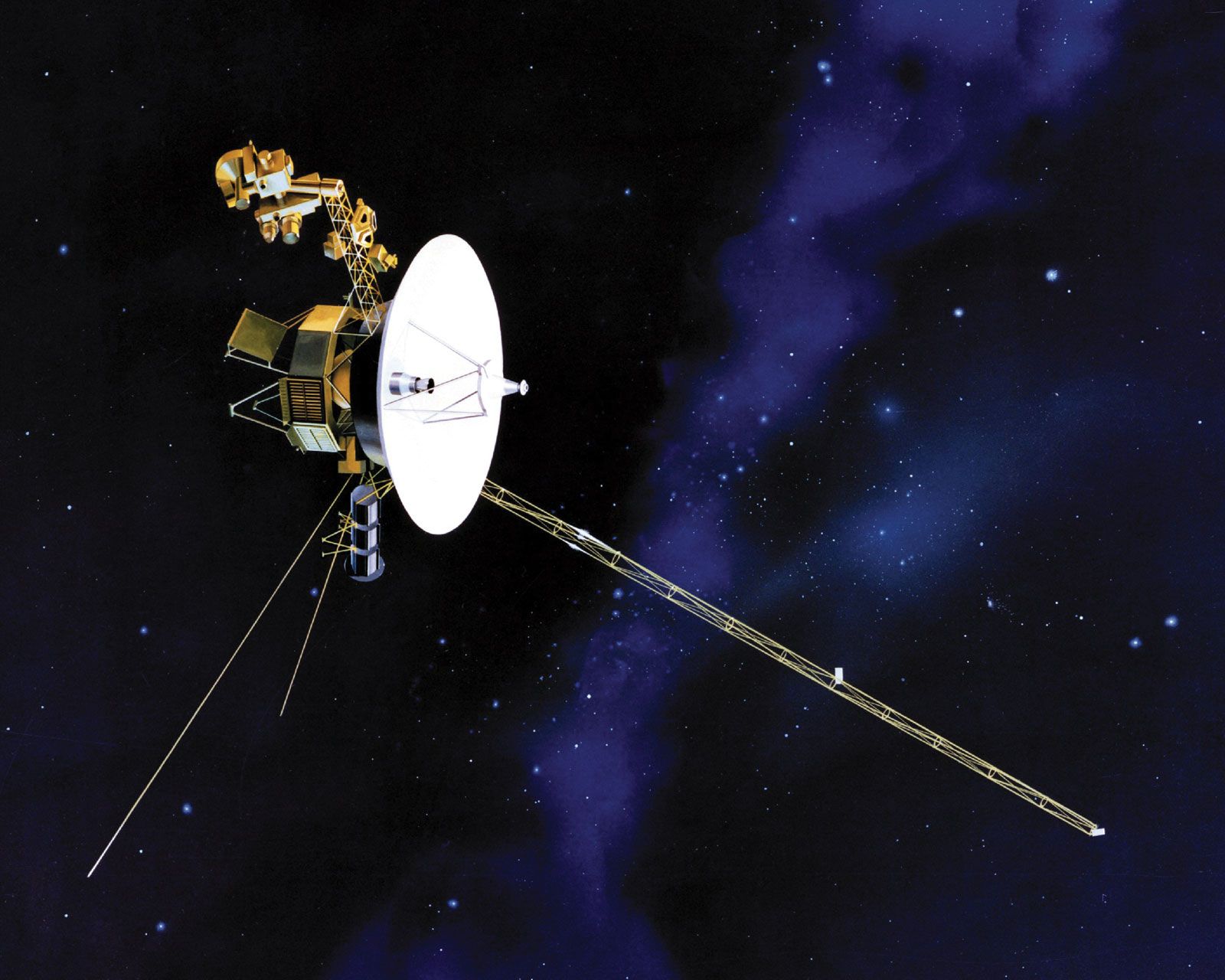
Voyager 1 is one of the most important space missions in human history. It is a robotic space probe launched by NASA on September 5, 1977, to study the outer planets and then travel beyond our solar system. Even after more than four decades, Voyager 1 is still sending data back to Earth, making it the farthest human-made object in space.
The main goal of Voyager 1 was to explore Jupiter and Saturn. In 1979, it sent back the first detailed images of Jupiter’s moons, including Io, which showed active volcanoes for the first time. In 1980, Voyager 1 flew past Saturn and captured stunning pictures of its rings and moon Titan, revealing that Titan has a thick atmosphere. After this, NASA directed Voyager 1 toward the edge of the solar system.
In 2012, Voyager 1 became the first spacecraft to enter interstellar space, the region between stars. It crossed the heliopause, the boundary where the Sun’s influence ends and interstellar space begins. This was a historic achievement, proving that a human-made object had finally left the solar system.
Voyager 1 is powered by radioisotope thermoelectric generators (RTGs), which produce electricity from the heat of decaying plutonium. This allows the spacecraft to function even in deep space, far from the Sun. However, its power is slowly decreasing, and some instruments have already been turned off to save energy.
One of the most special features of Voyager 1 is the Golden Record. This is a gold-plated copper disc that carries sounds, music, greetings in 55 languages, and images from Earth. It was designed as a message to any intelligent life that might find the spacecraft in the future, showing what life on Earth is like.
Today, Voyager 1 is more than 24 billion kilometers away from Earth, and its radio signals take over 22 hours to reach us. Scientists still use its data to study cosmic rays, magnetic fields, and conditions in interstellar space.
Voyager 1 represents human curiosity, courage, and the desire to explore the unknown. Even as it travels alone through the darkness of space, it continues to teach us about our universe and reminds us how far human imagination and science can go.

Author: Utkarsh_bauddh
Hello! I am Utkarsh Bauddh.