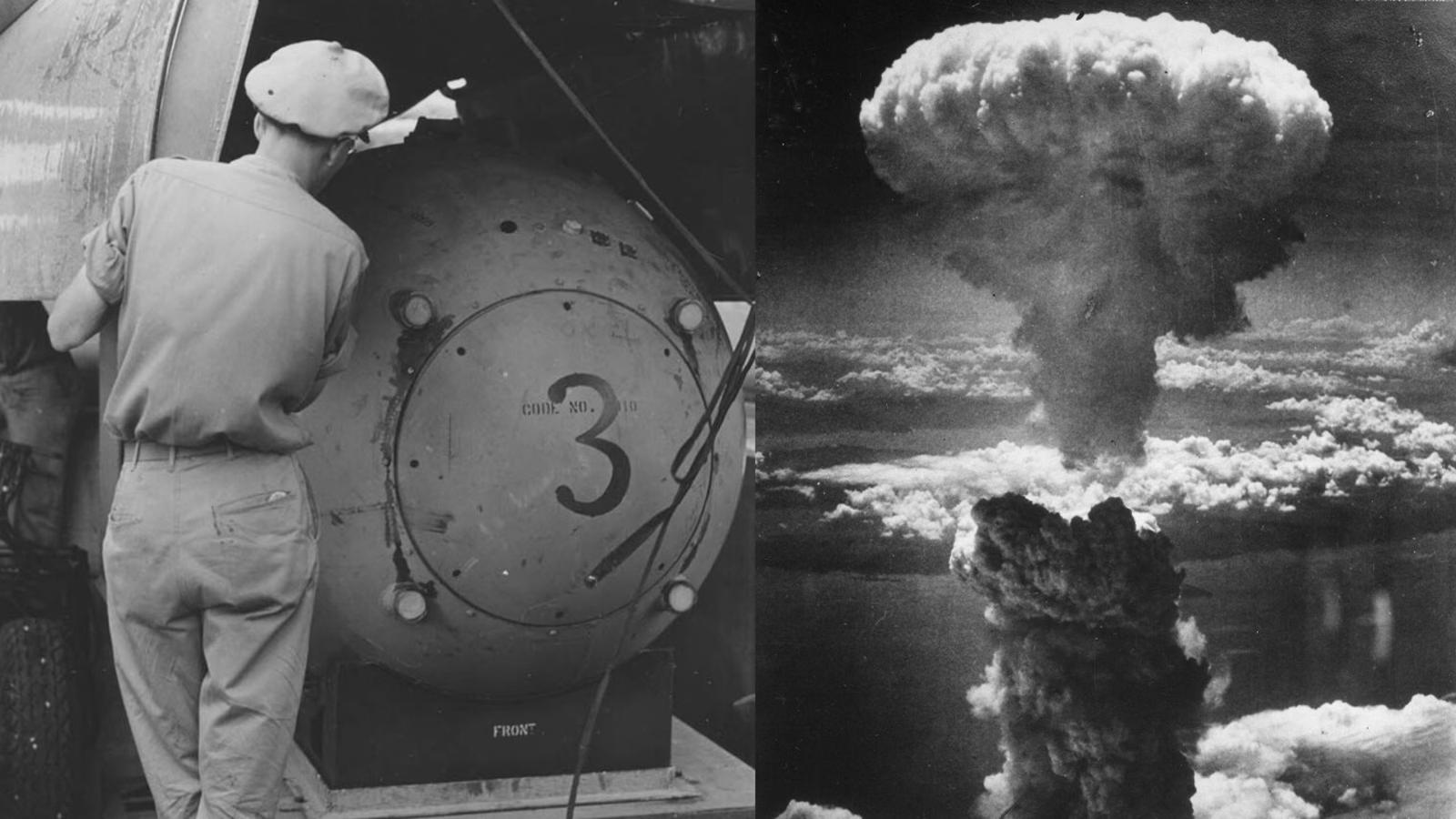
The Manhattan Project was one of the most significant scientific and military undertakings in human history. It was a secret U.S.-led program that developed the world’s first nuclear weapons during World War II. Its impact extended far beyond the war, shaping global politics, international security, scientific research, and moral debates for decades to come. To understand the Manhattan Project, it is essential to explore its origins, scientific foundations, key figures, challenges, achievements, and long-lasting consequences.
Origins and Global Context
The Manhattan Project was born out of an atmosphere of fear, urgency, and rapid technological change. In the late 1930s, the world was becoming increasingly unstable. Nazi Germany, under Adolf Hitler, was expanding aggressively in Europe. At the same time, scientific discoveries in nuclear physics were raising new possibilities—and dangers.
In 1938, German scientists Otto Hahn and Fritz Strassmann discovered nuclear fission, the process in which the nucleus of an atom splits into two smaller parts, releasing a huge amount of energy. Soon after, physicists Lise Meitner and her nephew Otto Frisch explained the phenomenon theoretically. The discovery alarmed scientists worldwide. If fission could be controlled and triggered in a chain reaction, it could release unprecedented destructive power—potentially creating a bomb far stronger than any weapon known at the time.
Many European scientists, particularly Jewish scientists fleeing Nazi persecution, understood the danger of Hitler controlling such a weapon. Among these refugees was Albert Einstein, the world’s most famous scientist, who had fled from Germany to the United States in 1933. Although Einstein was not directly involved in building the bomb, his name became associated with the project because of a critical letter he signed.
In August 1939, physicist Leo Szilard, along with Einstein and others, wrote a letter to U.S. President Franklin D. Roosevelt. The letter warned that Germany might be developing an atomic bomb and urged the United States to begin its own research. Roosevelt responded quickly. He created the Advisory Committee on Uranium, which marked the beginning of American involvement in nuclear research.
Early Research and Formation of the Project
For the first two years, progress was slow. Small-scale research was conducted at universities such as Columbia, Berkeley, and the University of Chicago. But after the United States entered World War II in December 1941, following the attack on Pearl Harbor, the atmosphere changed dramatically. The U.S. government realized it needed to accelerate nuclear research to keep pace with the possibility of German advances.
In 1942, the project was officially named the Manhattan Engineer District, later shortened to the Manhattan Project, because its initial offices were located in Manhattan, New York. The U.S. Army Corps of Engineers took control, placing General Leslie R. Groves in charge. Groves was known for his strict leadership style, organizational ability, and determination. Under his direction, the project grew rapidly into a massive industrial and scientific enterprise.
General Groves selected J. Robert Oppenheimer, a brilliant theoretical physicist from the University of California, Berkeley, to lead the scientific work. This decision was surprising to some, since Oppenheimer had never managed a large project before. However, Groves recognized that he had extraordinary intellectual ability, deep knowledge of physics, and the charisma needed to bring together scientists with diverse expertise.
Scientific Foundations of the Bomb
To create an atomic bomb, scientists needed to solve several key scientific and engineering challenges:
1. Producing Fissile Material
Two materials were deemed suitable for nuclear weapons:
- Uranium-235, a rare isotope of natural uranium
- Plutonium-239, an element that does not occur naturally and must be created in a nuclear reactor
Producing enough of either material required enormous industrial effort.
Uranium enrichment efforts were centered at Oak Ridge, Tennessee. Several different methods were tested:
- Gaseous diffusion
- Electromagnetic separation (led by Ernest Lawrence)
- Thermal diffusion
These facilities consumed huge amounts of electricity and manpower, but eventually produced enough uranium-235 to fuel one bomb.
Plutonium production required nuclear reactors. The first major plutonium facility was built at Hanford, Washington. Plutonium was manufactured by bombarding uranium-238 with neutrons in a reactor. Hanford became one of the most technologically advanced sites of the project.
2. Achieving a Controlled Chain Reaction
A chain reaction occurs when neutrons released by fission trigger further fission events. To test this idea, physicist Enrico Fermi and his team built the world’s first nuclear reactor—Chicago Pile-1—under the stands of a football stadium at the University of Chicago. On December 2, 1942, the reactor achieved the first successful, controlled, self-sustaining nuclear chain reaction. This experiment proved that nuclear energy could be harnessed and that plutonium production was possible.
3. Designing the Bomb
Two main bomb designs were developed:
- Gun-type bomb: used for uranium-235
- Called “Little Boy”
- Simpler design, similar to firing one mass of uranium into another to reach critical mass
- Implosion-type bomb: used for plutonium
- Called “Fat Man”
- Much more complex; used high-speed explosive lenses to compress a plutonium core
The implosion design required extensive testing because plutonium behaved differently from uranium during fission. This complexity led to the most famous test of the project: Trinity.
Secret Cities and Massive Scale
The Manhattan Project was unlike anything the world had seen. It employed more than 130,000 people, many of whom did not know what they were working on. Entire secret cities were built to support the project:
1. Los Alamos, New Mexico
The central laboratory where bomb design and assembly took place. Scientists, engineers, mathematicians, and their families lived in a tightly controlled community. Oppenheimer chose this remote desert site because it offered privacy and safety.
2. Oak Ridge, Tennessee
Focused on uranium enrichment. Thousands of workers lived in a town built from scratch for the project.
3. Hanford, Washington
Dedicated to plutonium production. The world’s first large-scale reactors were constructed here.
Other sites included:
- University of Chicago (basic research)
- Berkeley Radiation Laboratory
- Canadian and British research centers that cooperated with the project
The scale of the project demanded vast financial resources. The final cost was around $2 billion at the time (equivalent to over $25–30 billion today).
The Trinity Test
After years of intense work, the first atomic device was ready. On July 16, 1945, in the desert near Alamogordo, New Mexico, the United States conducted the Trinity Test. The bomb, nicknamed “The Gadget,” was an implosion-type plutonium device.
At exactly 5:29 a.m., the device was detonated.
Witnesses described a brilliant flash, a massive fireball, and a mushroom cloud rising more than 7 miles into the sky. The explosion was stronger than predicted—equivalent to about 21 kilotons of TNT.
Oppenheimer later said that a line from the Hindu scripture Bhagavad Gita came to his mind:
“Now I am become Death, the destroyer of worlds.”
The test confirmed that nuclear weapons were now a reality.
Use of Atomic Bombs in World War II
By mid-1945, Germany had surrendered, but the war in the Pacific against Japan continued. Japanese forces showed no sign of giving up despite massive casualties and the destruction of many cities by conventional bombing. U.S. leaders believed that using atomic bombs could end the war quickly and save lives that would be lost in a land invasion.
Bombing of Hiroshima
On August 6, 1945, the uranium bomb “Little Boy” was dropped on Hiroshima, a major Japanese city. The explosion killed approximately 70,000–80,000 people instantly, with tens of thousands more dying from radiation exposure and injuries over the following months.
Bombing of Nagasaki
On August 9, 1945, the plutonium bomb “Fat Man” was dropped on Nagasaki. Around 40,000 people died immediately, with total casualties eventually reaching more than 70,000.
Japan’s Surrender
On August 15, 1945, Japan announced its surrender, bringing World War II to an end. The atomic bombs played a central role in this decision, although historians continue to debate their necessity.
Aftermath and Global Impact
The Manhattan Project changed the world in multiple ways:
1. Beginning of the Nuclear Age
The successful development of atomic weapons marked the start of a new era. Nations now had access to weapons capable of destroying entire cities.
2. Cold War and Arms Race
Soon after the war, tensions grew between the United States and the Soviet Union. The Soviets developed their own atomic bomb in 1949, triggering a nuclear arms race. Both countries later developed even more powerful hydrogen bombs.
3. International Politics
Nuclear weapons became central to global strategy, diplomacy, and conflict prevention. Concepts like deterrence and mutually assured destruction shaped global affairs for decades.
4. Scientific and Technological Progress
The project accelerated advancements in:
- Nuclear physics
- Engineering
- Computing
- Materials science
- Reactor technology
Many of these developments later contributed to peaceful uses of nuclear energy.
5. Ethical and Moral Questions
The creation and use of atomic bombs raised profound questions:
- Should scientists create weapons of mass destruction?
- Was the bombing of Hiroshima and Nagasaki justified?
- How should the world manage nuclear technology?
These questions continue to influence debates today.
6. Radiation Effects
The Hiroshima and Nagasaki bombings created long-term health problems, including cancer and birth defects. These effects highlighted the horrific consequences of nuclear warfare.
The Legacy of Key Figures
J. Robert Oppenheimer
Known as the “father of the atomic bomb,” he faced political persecution after the war due to his opposition to hydrogen bomb development. His security clearance was revoked in 1954 but symbolically restored in 2022.
General Leslie Groves
Remembered for his extraordinary management skills, Groves led one of the largest and most secretive military engineering projects in history.
Enrico Fermi, Niels Bohr, Richard Feynman, and Others
Many brilliant scientists contributed to the project, and their work transformed modern physics.
Long-Term Consequences
Nuclear Non-Proliferation
After the war, efforts were made to control the spread of nuclear weapons. The Nuclear Non-Proliferation Treaty (NPT) of 1968 remains a cornerstone of global nuclear policy.
Nuclear Power
Research from the Manhattan Project laid the foundation for civilian nuclear power plants. Today, nuclear energy provides electricity to millions of people worldwide.
Public Awareness
Images and reports from Hiroshima and Nagasaki made people aware of the devastating effects of nuclear war. Movements for peace and disarmament grew stronger as a result.
