World War I, also known as the Great War, was already three years old when the year 1917 arrived. Much of Europe had been consumed by trench warfare, massive casualties, political instability, and economic exhaustion. Although the war had begun in 1914, the final two years—1917 and 1918—played a decisive role in shaping the outcome of the conflict and altering the world order. These years witnessed dramatic political revolutions, the entry of new great powers, military breakthroughs, technological evolution, and the collapse of several long-standing empires. The period from 1917 to 1918 transformed the war from a seemingly endless stalemate into a fast-moving series of events that ultimately forced Germany and the Central Powers to accept defeat.
1. The World in Early 1917: Exhaustion, Crisis, and Stalemate
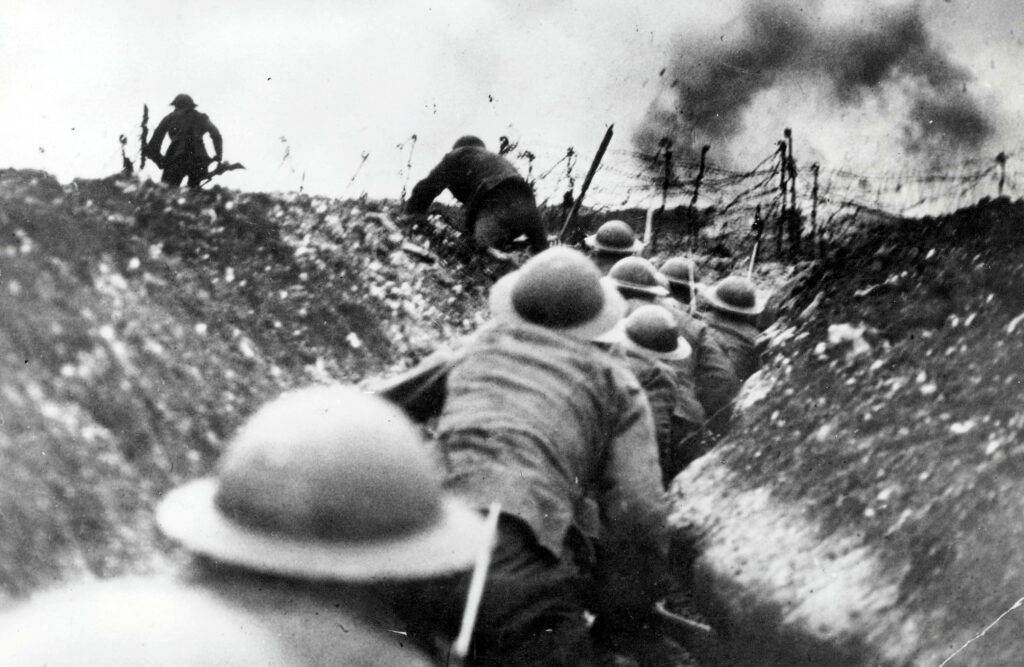
By early 1917, the European continent was locked in a brutal and bloody stalemate. The Western Front had barely moved despite millions of casualties. The trenches from the North Sea to Switzerland had become symbols of strategic paralysis. Soldiers lived under constant threat: artillery bombardment, machine-gun fire, mustard gas, mud, disease, and mental trauma. Every offensive—whether the Somme or Verdun—had led to staggering losses with minimal territorial gains.
Meanwhile, the home fronts of Britain, France, Germany, and Austria-Hungary were suffering scarcity of food, inflation, labor shortages, and growing public dissatisfaction. Although propaganda tried to keep morale high, disillusionment spread throughout civilian populations.
In this context, 1917 began as a year of uncertainty and fatigue. Yet it soon became the most transformative year of the war, one that changed the balance of power. Read Also .. Mexican–American War (1846–1848)
2. The Russian Revolution: A Major Turning Point
One of the most dramatic developments of 1917 was the collapse of the Russian Empire. Years of military defeats, economic hardship, and political corruption ignited a revolution in February 1917. Tsar Nicholas II abdicated, ending the Romanov dynasty and centuries of imperial rule.
The provisional government that replaced him attempted to continue the war, believing that withdrawal would weaken Russia’s international influence. However, the weary Russian soldiers and civilians had lost all will to fight. Desertion rates skyrocketed, and discipline crumbled.
By late 1917, the Bolsheviks led by Vladimir Lenin seized power in the October Revolution. Lenin, committed to ending Russia’s involvement in the war, signed the Treaty of Brest-Litovsk with Germany in March 1918. This treaty transferred large areas of land to the Central Powers, freeing German troops to move to the Western Front.
Although this strengthened Germany temporarily, it also had long-term consequences: the absence of Russia paved the way for American involvement to become even more important in the final outcome.
3. The United States Enters the War (April 1917)
The most significant global development in 1917 was the entry of the United States into the war on the side of the Allies.
3.1 Why America Joined
For more than two years, the United States had remained neutral. President Woodrow Wilson believed in staying out of the conflict and using diplomacy to maintain peace. However, several events pushed America toward involvement:
Unrestricted Submarine Warfare
Germany resumed its policy of sinking ships without warning, including civilian and neutral vessels. The sinking of ships with American passengers created widespread outrage in the U.S.
The Zimmermann Telegram
In early 1917, British intelligence intercepted a message from Germany inviting Mexico to join a war against the United States in exchange for promises of American territory. When this telegram was made public, American opinion turned sharply against Germany.
Economic and Cultural Ties
The U.S. had strong trade relationships with Britain and France. Many Americans felt closer culturally and politically to the Allies than to the Central Powers.
Moral Arguments
Wilson framed the war as a fight to “make the world safe for democracy.” This idealistic reasoning resonated with many citizens who believed it was time to defend democratic values.
On April 6, 1917, Congress formally declared war on Germany. Although the U.S. did not have a large standing army at the time, its economic power, manpower, and industrial might would prove decisive.
4. Mobilization of the American War Machine
Once in the war, the United States had to mobilize quickly.
4.1 The Selective Service Act
The government passed a draft law to recruit millions of soldiers. By war’s end, around 4.7 million Americans served in the military, with more than 2 million deployed to Europe.
4.2 Industrial Expansion
Factories shifted to producing weapons, ammunition, aircraft, and vehicles. The U.S. became the supplier of essential materials to the Allies.
4.3 Transport and Logistics
One of the greatest contributions of the U.S. was its shipping power. Troops and supplies crossed the Atlantic despite the threat of German U-boats. The convoy system, introduced by the Allies, drastically reduced ship losses.
4.4 American Expeditionary Forces (AEF)
General John J. Pershing led the AEF. Pershing insisted that American forces fight as independent units rather than being absorbed entirely into British or French divisions. This decision preserved American identity in battle and allowed U.S. troops to participate directly in major offensives.
By late 1917, the first American soldiers reached the Western Front, but their major contribution came in 1918.
5. The Western Front in 1917: A Year of Failed Offensives
1917 witnessed many large Allied offensives that resulted in high casualties but little strategic success.
5.1 The Nivelle Offensive
France launched a major attack under General Robert Nivelle. Soldiers had been promised a quick and decisive victory. Instead, the offensive failed disastrously, resulting in 187,000 French casualties. This led to widespread mutiny within the French army. Although the French soldiers refused to participate in suicidal attacks, they remained committed to defending the homeland. French leadership had no choice but to halt major operations for months.
5.2 The Battle of Passchendaele (Third Battle of Ypres)
This British-led offensive has become infamous for its horrific conditions. The battlefield turned into a sea of mud due to heavy rain and artillery bombardments. Many soldiers and horses drowned in the quagmire. After months of fighting, Britain gained only a few miles at the cost of hundreds of thousands of casualties.
5.3 Italy’s Struggles at Caporetto
In late 1917, the Italian army suffered a devastating defeat at Caporetto when German and Austrian forces launched a surprise attack. Italy lost hundreds of thousands of soldiers as prisoners or casualties, and Allied reinforcements had to stabilize the front.
These failures increased the urgency of American involvement. The Allies desperately needed fresh manpower, new ideas, and a boost in morale.
6. 1918: Germany’s Last Chance – The Spring Offensives
With Russia out of the war and the American army not yet fully deployed, Germany saw a narrow opportunity to win the war. In March 1918, they launched a massive series of attacks known as the Spring Offensives or Ludendorff Offensives.
6.1 Operation Michael
This offensive targeted the British army along the Somme. Elite German stormtroopers infiltrated enemy lines using new tactics: speed, surprise, and flexible command. The Germans advanced farther in days than they had in previous years.
6.2 Other Offensives
Germany launched additional attacks along different parts of the Western Front: Operation Georgette, Operation Blücher-Yorck, and others. Their goal was to divide the Allies, capture Paris, and end the war before the American military could become fully operational.
6.3 Why the German Offensives Failed
Although initially successful, the offensives overstretched German supply lines and exhausted their last reserves. German soldiers became worn out, and morale declined as they realized victory was slipping away. Crucially, American troops began arriving in vast numbers, strengthening the Allied forces.
By July 1918, the German offensives had failed to achieve a decisive breakthrough. Their army had suffered enormous losses that could no longer be replaced.
7. The Allied Counteroffensive: The Hundred Days Offensive (August–November 1918)
Once the German assaults ended, the Allies launched a massive coordinated counteroffensive.
7.1 The Second Battle of the Marne
In July 1918, German forces attempted one more push toward Paris. However, they were met by powerful Allied resistance. American divisions played a crucial role in halting the German advance. This battle marked the turning point: from this moment onward, Germany was on the defensive.
7.2 The Allied Advance Begins
On August 8, 1918, the Allies launched the Battle of Amiens, known as the “Black Day of the German Army” because of the severe blow it dealt to German morale. Tanks, aircraft, artillery, and infantry worked together effectively, demonstrating a new type of coordinated warfare.
7.3 Continuous Pressure on Germany
For the next hundred days, the Allies relentlessly pushed the Germans back across the Western Front. American forces participated in major operations such as:
- The St. Mihiel Offensive
- The Meuse-Argonne Offensive (the largest American battle of the war)
U.S. soldiers, although inexperienced at first, fought with determination and played a decisive role in breaking German defensive lines.
7.4 Collapse of the Central Powers
As the Allies advanced, Germany’s allies began to crumble:
- Bulgaria surrendered on September 29.
- The Ottoman Empire signed an armistice on October 30.
- Austria-Hungary dissolved in early November amid nationalist revolts and military defeat.
Germany found itself alone, facing overwhelming enemy strength and internal collapse.
8. Germany’s Internal Collapse and the Armistice
By late 1918, Germany was collapsing from within.
8.1 Hunger and Exhaustion
Germany had faced years of naval blockade, causing food shortages, malnutrition, and civilian suffering. Factories lacked raw materials, and morale was extremely low.
8.2 The Kiel Mutiny
In late October 1918, German sailors refused orders to launch a hopeless final battle against the British fleet. Their revolt spread across the country, inspiring workers’ and soldiers’ councils similar to those seen in Russia.
8.3 The Abdication of Kaiser Wilhelm II
As revolution spread, the German government realized the monarchy could no longer survive. On November 9, Kaiser Wilhelm II fled to the Netherlands, ending the German Empire.
8.4 Signing the Armistice
On November 11, 1918, at 11:00 AM, an armistice was signed in a railway carriage in Compiègne, France. Fighting ceased, marking the end of the Great War.
9. The Human and Social Impact (1917–1918)
The final years of the war were marked not only by military conflict but also by profound social changes.
9.1 Women in the Workforce
With men fighting at the front, women entered factories, farms, and offices in unprecedented numbers. Their contributions played a critical role in maintaining the home front. After the war, many women demanded greater political rights, including the right to vote.
9.2 Psychological Trauma
Shell shock (now known as PTSD) affected thousands of soldiers. The horrors of the trenches left permanent mental scars.
9.3 The Influenza Pandemic
In 1918, a deadly worldwide influenza outbreak killed millions of people—far more than the war itself. Soldiers moving across continents accelerated the spread of the disease.
9.4 Economic Disruption
The war damaged businesses, destroyed farmlands, and burdened nations with massive debts. Entire regions had to be rebuilt.
10. The Treaty of Versailles and the New World Order
After the armistice, the victorious Allies negotiated the Treaty of Versailles in 1919. Although outside the specific scope of 1917–1918, its decisions grew directly from the final phase of the war.
The treaty imposed heavy penalties on Germany:
- Territorial losses
- Restrictions on the military
- Large reparations payments
- Acceptance of “war guilt”
These terms weakened Germany politically and economically, contributing to future instability and ultimately leading to World War II.
Meanwhile, several empires vanished:
- The Russian Empire
- The German Empire
- The Austro-Hungarian Empire
- The Ottoman Empire
New nations emerged in Europe and the Middle East. The United States became a major global power. The League of Nations was created as an early attempt at international governance.
11. Conclusion: Why 1917–1918 Defined the Outcome of World War I
The years 1917 and 1918 were decisive because they transformed the nature of the conflict and shifted the balance of power dramatically.
- Russia’s withdrawal eliminated one major front but created political shockwaves.
- America’s entry injected new manpower, resources, and morale into the war.
- Germany’s Spring Offensives were bold but ultimately unsustainable.
- The Allied Hundred Days Offensive crushed German military capability.
- Internal revolutions and economic collapse destroyed the Central Powers from within.
- The Armistice of November 11, 1918 ended the bloodiest war the world had ever seen.
The final two years of World War I were therefore a time of dramatic shifts—military, political, economic, and social—that reshaped global history. They marked the fall of old empires, the rise of new powers, and the emergence of modern warfare and diplomacy. Although the war ended in 1918, its consequences would shape the 20th century in profound ways.
